
Theo Chocolate – artisan chocolate maker

by admin on March 11, 2010

Joe Whinney has built Seattle-based Theo Chocolate into the artful business it is today. What began as a childhood love of chocolate turned into a personal mission when Joe began working with Mayan cocoa growers in Belize. The only organic, fair trade, bean-to-bar chocolate maker in the U.S., Theo has brought superior taste and luxury back to what was once revered as the food of the gods. Artisan confections and chocolate bars ranging from classic to fantasy flavor combinations make up the product line at Theo. Joe’s vision goes far beyond mere product to include Theo’s Chocolate University and an unwavering commitment to enriching the lives of everyone from cocoa growers to fellow chocolate lovers.

Single-country Origin chocolate bars from Theo

Find an expanded interview with Joe Whinney in my new book Field Trip:Volume One, available on Amazon here! Or read more about my new book here.

Theo is the only organic, fair trade, bean-to-bar chocolate factory in the U.S., and a great example of taking a more holistic approach to doing business. Can you talk a bit about what the word luxury means to you?

Luxury is something that we enjoy, something that’s rare and not very common, and also something that is, in my opinion, really good for everybody who helps to create it and who enjoys it. It is kind of an interesting juxtaposition when you think about chocolate, because the industry, the products that most people consume and what most of the industry is producing, are really sort of these commodity-type products — you know, brown, cheap and sweet. And they’ve taken what really historically has been this gift from God, these cocoa beans. To the Mayans, it was almost a religious component of their lives. Not only was it money, but it was used in a lot of their religious rituals, the color of the drink was similar to the color of blood, and they felt it was given to them by God. So something that is of that extreme value, to bring it down to what I think overall is a very base level, there’s no luxury in that! Although it could be a very luxurious product.

There’s a certain idea around hedonism, which is that hedonism somehow for some people, they assume there’s something bad about it. It has to be an indulgence that is either not good for you or not good for someone else or that there’s some sort of negative consequence. And I don’t believe that that has to be the case. You can be hedonistic, you can enjoy luxury, without it having a negative impact on someone else.

Food of the Gods basket of chocolate from Theo

Take me back to your childhood falling in love with chocolate and pioneering the supply of organic cocoa beans into the U.S. in 1994. When did chocolate go from being this kind of love or indulgence to the basis of your career?

I didn’t exactly know it at the time, but when I was a conservation volunteer for a small conservation foundation in southern Belize — this was in the early ’90s — I had no skills at all. I had a good strong back, I was a healthy kid, so they sent me out into the bush with these cocoa farmers to help them harvest cocoa. You know, I tell this story a lot, because it was really miraculous. I had no idea how cocoa grew or where it grew, and all I knew was Halloween candy that was chocolate! And after spending the first day with these Mayan farmers in the rainforests with incredible sounds and smells and giant buttress trees and snakes, and then tasting the fruit around the cocoa seed — the seed is what chocolate is made out of — I couldn’t believe that this was chocolate! It was such an incredible adventure. And I think at that point it went from, ‘I really enjoy this product chocolate a lot!’ to ‘This is an incredible adventure!’ And I just wanted to go as deep as I possibly could.

You’ve exhibited a good deal of persistence and faith in building Theo into what it is today, from working with cocoa growers in Central America and Africa, to moving from Cambridge to build your business in Seattle, to months of planning and then a year and a half of building your factory in an historic building. Was your vision of what Theo could be pretty close to what you’ve created today?

I would say yes, although I’ve been pleasantly surprised in a lot of ways. The original plans for Theo I started cooking up, you could say, in the late ’90s around ’97 or ’98, and I was already in the cocoa industry and working with chocolate manufacturers and cocoa farmers throughout North and South America, Europe and Africa. And I started to shape a fairly good view of what I thought good chocolate was and should be. I feel like it’s still a struggle for us because, you know, organic food went through a little trajectory where if it’s organic, it must be cardboard. Organic oatmeal cookies in the early ’90s — it was like a fate worse than death! I mean, it was very healthy, but, my god, you would not want to eat it!

And now it’s gone to being a much deeper understanding and a broader tent, so to speak, and I think now organics is a much more positive thing. But the fact that we’re producing organic products buttonholes us, I think, for some consumers. And this kind of goes back to luxury. So where I’ve been most surprised is the consumer response to what I consider to be some of our finest products. The quality is so good that people have been able to sort of leap over this idea of organic and not let that get in the way. And they’re starting to see more quickly than I would have anticipated that fine and beautifully made organic chocolate is as good or better than the best chocolate creations made anywhere around the world.

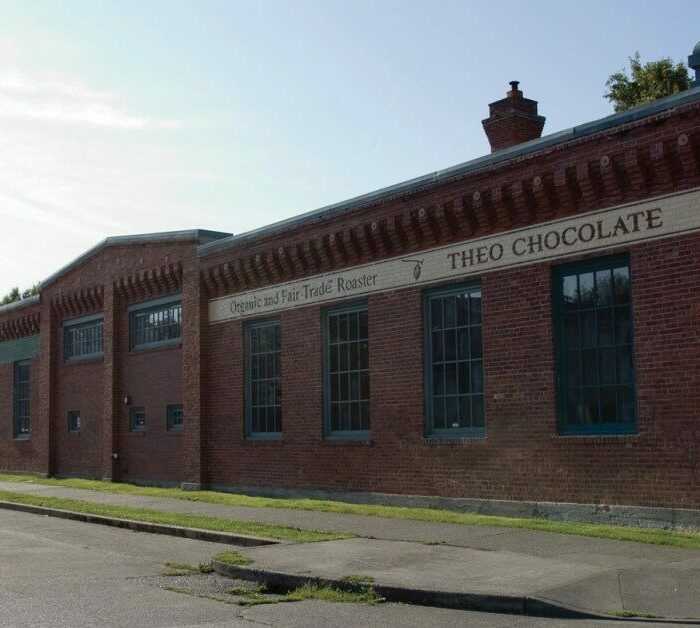
Exterior of Theo factory in Seattle

Cocoa bean roaster at the Theo factory

For those who aren’t familiar with Theo, tell us about your various product lines.

We have confections, which are hand-made ganache, pralines, artful chocolate creations that are done on a very, very small scale and are really at our premium price. On the chocolate bar side, we produce a small line of Origin bars where we name the origin country, and it’s really the most basic dark chocolate that we produce, with a very high cocoa percentage. We have a line of what we call Fantasy Flavor bars, and these are really unique flavor combinations like Curry Coconut Milk Chocolate, Fig, Fennel and Almonds, we do a Bread and Chocolate flavor, which is my personal favorite, and these are really unique and innovative flavors. And then we have what we call the Classic bar line, which are more traditional flavor combinations in chocolate like Cherry and Almond Dark Chocolate, Orange and Dark Chocolate, 45% Milk Chocolate, and these are very accessible for the broadest swath of consumers.

We’ve won awards for our chocolate bars, but the confections have really garnered a lot of attention. They’re highly perishable, so there are only a few places that we actually sell them, and they’re mostly at our factory or on the web.

Salted Caramel pack from Theo

Bread & Chocolate dark chocolate bar from Theo

Coconut Curry milk chocolate bar from Theo

Classic chocolate bars from Theo

One thing that makes Theo practically jump out at you is the wonderful branding and packaging. How did this personality and identity come about?

Thank you — that means a lot. You know, when we first started, we had a local artist Zara who did our logo and our initial packaging. And we were very clear about what we wanted, the attributes for the logo specifically. And, I have to say, it’s one of my favorite logos that I’ve ever seen — I just adore it. She was able to really capture what it was we wanted to communicate with the logo, and that’s the heart of our brand. And the packaging for me, it’s almost as though whatever comes around that is happy, because the logo is so strong.

In the rest of the packaging, we’ve done some things really well and some things not so well. One quick example is originally on our Origin bar line, which is what we were launching first, we were so enamored with Zara’s original art that we didn’t even say ‘chocolate’ anywhere on the front of the package! It was just ’84% Cacao Ghana.’ Now, if you’re a chocolate geek like we are, that might mean something to you. But the vast majority of people who encountered it had no idea what the hell this thing was! They’d say, ‘Oh, that’s beautiful!’ but they didn’t know what to do with it. So we definitely learned some lessons early on, and I feel as though we’re continuing to learn them. And there’s a lot of input that goes into our packaging, and I think some of it works well as far as communicating what the product is to people, and I think some of our packaging does not do as good a job of telling consumers what the product is.

Toasted Coconut seasonal chocolate by Theo

Vanilla Milk Chocolate bar from Theo

Big Daddy peanut butter chocolates from Theo

Also inherently part of the Theo brand is your commitment to sustainability in various forms, including packaging, sourcing, energy resources, and even fair wages and educational opportunities for the families of the growers. This is an enormously complex and challenging undertaking — how are you managing it all, and does it feel like the learning curve never ends?

Yes, it does feel like the learning curve never ends, in large part because there seems to be every day more innovation and more awareness around what social and environmental issues are. And so we always are interested in trying to be at the leading edge of this, because we do want to have a positive impact. At the heart of it, I didn’t start a chocolate company to make money. I mean, we all need to make money, but that’s not what drove me. What drove me was to create a beautiful product that really had a positive impact on everyone it touched. So it’s really at the heart of our business, and the challenge is that as a small and rapidly growing company, when your resources are really tight, it’s hard to sometimes allocate the resources that are needed to really hit that environmental gold standard. And we’ve been able to do it pretty well, but it can be challenging.

We’re four years old now, and it was very clear to me that if the company wasn’t profitable and wasn’t financially stable and had products people wanted, etc., we couldn’t accomplish our mission. So there really was a strong focus just on the basic business mechanics early on while we were doing what I considered to be baseline work around social environmental sustainability. Now that we’re at the point where our growth and our profitability are all kind of syncing up properly, it’s a little bit easier for us to try to stay at the leading edge of these issues and really provide the kind of leadership that I think we have in some regards, but I’d like to go deeper.

Going back to this whole notion of cocoa as a commodity is that since it is a consumer issue, what we’re trying to do is increase the perceived value of cocoa and chocolate products, because if we can do that and consumers are willing to pay more for something of excellent quality that they love and that is good for everyone in the chain, then we have an opportunity to pay a better price to farmers — and we do a good job with that already — but then that allows them to invest in their future, they can increase their security, and there are all of those benefits.

Coffee Dark Chocolate bar from Theo

For everyone who loves chocolate and has felt guilty about it, you’re here to assure us it’s actually good for us, right?

Yes, dark chocolate, 70% or higher. The cocoa bean is very, very complex, and it’s very similar to a lot of seeds. We think of seeds as being good for us, but most seeds are very high in fat. In the case of cocoa beans, cocoa butter actually moves through your body relatively quickly, so the calories from cocoa butter are less impactful than, say, some dairy fat. But the real heart of the health benefits are the antioxidants. The antioxidants of cocoa beans have several different benefits, and one of the most important is they are vasodilators — they open up your blood vessels. It lowers your blood pressure, helps deliver oxygen to your extremities — it’s amazing how circulation can have an impact on your overall health. And it also has the cellular benefits. We think of antioxidants as something that actually sparks or provides cellular health, and certainly those benefits are realized through cocoa.

The things about chocolate that aren’t good for you is really the sucrose or the sugar that’s added to counteract bitterness. Which is why dark chocolate is so important, because the higher the percentage, the less sugar, the more health benefits, the less you’re consuming ingredients that are not as good for you. And we don’t use any soy lecithin in our products.

You go beyond business as usual to educate the public through regular tours of your operation and through your Chocolate University. Can you tell me more about this effort?

At the heart of sustainability is that it has to be consumer-driven. So a big part of our mission is to provide information and education that allows consumers to be informed about what’s going on. And we do this across the board within our product format. So, of course, we educate about where cocoa comes from, and the farmers and the countries where cocoa is grown, but we also talk a lot about how chocolate is made. We talk a lot about what makes good chocolate so fabulous, we teach people how to make chocolate, how to work with it in their own kitchens. We also do a lot on the science behind chocolate and just how you can have fun with it and do taste pairings. And it’s really the entire universe of chocolate we want people to understand, because the more they appreciate it and the higher they perceive the value of it, the greater chance we as an industry have to have a positive social and environmental benefit. So we perceive this to be a consumer issue, and we want to educate consumers so they can make better choices.

Daily tours of Theo Chocolate

You mentioned the pairings — tell me about the wine and beer pairings on your site.

So you would buy our pairing kit, and it will come with the chocolate bars that we think pair well with certain types of beer or wine, as well as a placemat and tasting notes and suggestions. The idea is that if you wanted to have a small party and do a beer pairing, you’ll have everything you need to do that except for the beer, but we make suggestions of what kind of beer you could pair with. It’s interesting, because the wine industry has done such a gorgeous job of promoting uses of their products, we think of it from a culinary standpoint as kind of the most culinary alcoholic beverage. And the truth is that anything that has flavor really is culinary. It’s the contrast of flavors that has the most value and the most interest. So part of the reason we do beer pairings is just so that we can expand our idea about food and flavor combinations.

Chocolate and beer pairing kit from Theo

Chocolate and wine pairing kit from Theo

I’m a huge fan of Jane Goodall. Tell me about your ‘Good For All’ chocolate bars and your relationship with Jane’s organization.

It’s primarily that we raise money for her effort, which is global, through the sale of those chocolate bars. However, where there are practical tie-ins, we pursue them. So one example right now is Tanzania. Jane started her work in Tanzania, they have an environmental office there, and they introduced me to a group of cocoa farmers in the western region with a fairly large number of farmers who were interested in fair trade and organic production. We definitely saw we could have a positive environmental impact, and they don’t have a ready market. They actually do sell to some of our competitors, but the price the farmer is getting is horrible. They’re earning less than $400 a year for their entire family, and it’s certified organic. So this is a very complicated story, but the bottom line is that we now have funding under an international NGO to not only improve their quality so they can get a better price but also create market linkages with Theo and other buyers who are willing to be transparent and pay a better price. So that’s one example of how our relationship with Jane Goodall is having a practical impact on people on the planet, but most if it is us funding her work, which we’re huge fans of.

Good For All chocolate bars from Theo to benefit the Jane Goodall Foundation

What’s next for Theo and your chocolate revolution?

Well, you know, it’s interesting. We do have some new product formats coming out, but one of the things that we’re very interested in is we’ve been able to create some very delicious products in the lab only that are focused on the high health benefits of chocolate. And so it’s kind of a tricky thing, because we’re very interested in bringing these kinds of products to the market, and we have some very, very unique technology. At the same time, we want to make sure it’s consistent and meets our overall mission. So we’re kind of working through some of the product formats and presentations and production challenges, and all that good stuff. But I think what you’ll be seeing from us is some product format sizes that really drive trial, so smaller package sizes, smaller portion sizes. And then I think after that you might see some really interesting products that strive to not only to give pleasure but even provide greater health benefits than just straight dark chocolate. We’ll see!

Besides chocolate, what are some of your favorite things in life?

Oh, gosh, I love love! I do a lot of sailing — sailing’s really important to me, and that’s one of the reasons Seattle is really fantastic. So being outdoors and in the wilderness and certainly out on the water is really important. And one of the things that has really become an increasingly important issue for me is education. I have a young son who is the center of my universe, and as he grows, I’m seeing how education really can have a huge impact on people’s lives and their trajectory. So I’ve been taking a much more serious interest in education than I ever thought. I didn’t graduate from high school and didn’t go to college because school was not my bag, so it’s ironic for me now that I’ve taken such a strong interest.

And then outside of that, good food, and because of my love for food and my place in the food industry, I’ve really taken a personal interest in hunger in our communities. You’ll be seeing some stuff from Theo in the coming months around this, but in this economy, the amount of people who are hungry and who have to make choices between paying rent and buying food or buying prescription medicines, or whatever it is that is going on in their lives, it’s just astounding. So those are the kind of things that are occupying my head space right now.

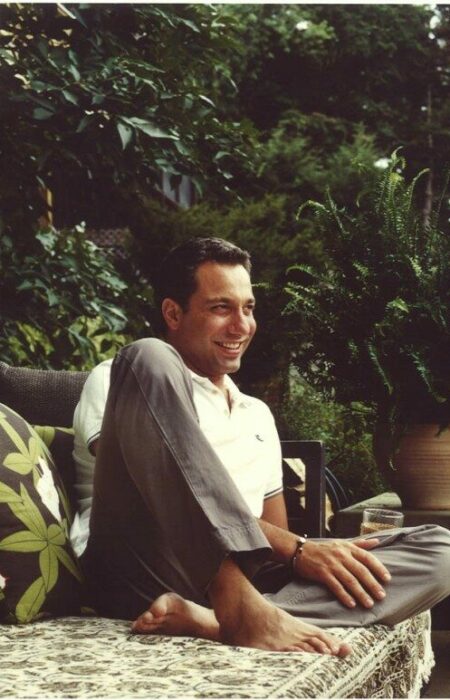
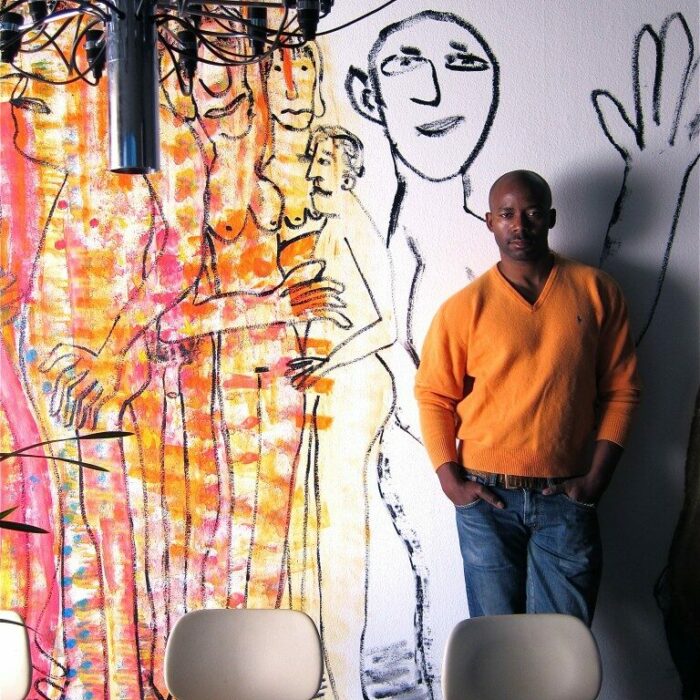
Joe Whinney, founder of Theo Chocolate

For information about the full product line, seasonal items, or factory tours, visit Theo Chocolate here.

Share the love, post a comment!

{ 6 comments }

Scosha – jewelry designer

by admin on March 4, 2010

Fantasy, soul, and the natural connection of things are at the heart of Scosha Woolridge’s jewelry designs. Originally from Australia, Scosha drew inspiration from her worldwide travels before eventually calling New York City home. Her happy mix of materials — including textiles, metals, leather, and precious stones — play off each other in a way that feels raw and authentic. Scosha approaches her work as a storyteller, incorporating words and materials that together create a personal narrative. Designing for both men and women, Scosha explores the sort of truth that can only be found in things made by hand.

Women's ring by Scosha

You think of yourself as a storyteller, creating a narrative through your jewelry designs. Is this narrative coming by way of a mood, an aesthetic, the materials, or something else?

It comes from many dimensions. It’s a fantasy creature that has been in my art for many years — that is the true underlying story and a whole story in itself. Jewelry making is an extension of that character, so I would say it’s mostly emotional. I’m obsessed with and excited about how well things naturally connect, without force. Whether it’s creating an art piece, designing a piece of jewelry, building a relationship, or playing a sport, there are so many colors, textures and layers to play and build with. It really can be like teeing off on a golf game — when you hit that sweet spot, that point of perfect connection, it is euphoric, and I get the same feeling through art and jewelry making. I know people feel it too, and that is what I am tapping into. It’s that indescribable satisfaction that I always want more of, so that’s what keeps me prolific. I’m simply addicted to that sensation.

Ring by Scosha

Bracelets by Scosha

Starry Night rings by Scosha

To take this question a step further, we’ve come out of a time in which it was all about the label and the bling factor and had very little to do with personal design or meaning. How do you see your work fitting into today’s culture?

I love things that are understated, raw, nonchalant but sincerely personal, a little unkempt in the sense that they run their natural course. Anything with too much polish is like erasing the truth. Fake, cheated, unattractive.

I think today, where mass production is so in our faces and has been for some decades and will continue to be so, where certain people are lucky enough to live in the modern world but are unlucky to have been bombarded by commercialism, they still crave hand-made and soulful things. It’s part of their core, it’s as important as healthy food is for the system.

The hand-made, with all its tiny details, enables you to really look closely and explore. It can stimulate a person to go to an emotional place, which can create positive feelings, new ideas, and a healthy state of mind.

Women's ring by Scosha

Love Story necklace by Scosha

Tell me about your time growing up in Australia and any early artistic influences, how you came to live in New York, and how your jewelry design career evolved.

My family moved to Sydney when I was 5, to an urban neighborhood, a lot of bush. I was very independent and imaginative, and it was hard for me to connect to most kids because I was bossy trying to get kids to play their part in my dance shows. I made puppet shows, and I did haircuts for the kids in the streets and charged them 5 cents. I tried selling old mirrors and flowers to adults in my street over and over again. I wrote secret poems and dropped them off in random letterboxes — things like that. My mother taught me to sew really young, so I started making clothing at the age of 6. My grandmother was a painter, so I always told people I was going to be a painter or a dancer.

I became a state athlete, breaking records and doing gymnastics still while being infatuated with making art all through my primary and high school years. I did very well, and I was a perfectionist.

I knew at 17 I wanted to go traveling and learn about other cultures. I was very interested in third-world countries, because all the textiles I saw in books blew my mind, so after I went through three years in art school, I worked three jobs — as a fitness trainer, picture framer and as a waitress — to save my pennies and then flew off to Thailand and India and other parts of the globe. It was in Brazil by about the 8th month and I was seriously missing having a conversation about modern art. In Portuguese or English this conversation never could happen, so I contacted a lady I met in Mexico that lived in the west village in New York, and she offered me a job as her helper for her new boutique. I was in New York only one week and I knew I found my place in the world. It was such a mix of everything in one spot, and I liked the pace at which things moved.

I learned and made weaving in Brazil, and I brought some with me, started selling them, and then it went from there. I never intended to become a jewelry maker. I had done and was interested in so many creative things! I really wanted to make stop-motion animation and paint all day long, so it was hard to make the decision to focus on jewelry as my profession. It took me a while to accept this is what I am going to be known for. It was more that it became a demand, and I really began to enjoy the business side that I was learning. And it was the obsessive connection to people that I could achieve that really kept me moving forward.

Ring by Scosha

Braided teal linen fly line bracelets by Scosha

Moon on golden peak with diamonds and rubies earrings by Scosha

I see you mix metals, leather, recycled cotton, antique textiles, and other materials in your work. Tell me about your inspirations for these choices and your creative process in playing with this mix.

It’s in the textures, and different molecular structures — they all have their strengths and weaknesses — and I like the way this plays off together, just like people. One could say, our life is not that different to a piece of string; we both have our place. Or you could say, I couldn’t choose just one material.

Day Dusk Night men's bracelets by Scosha

Men's waxed linen rings by Scosha

Follow the Sun men's necklace by Scosha

Do you approach your collections for men and women the same way?

I think so. I make things that I would wear, and I’m strongly influence by my masculine side. I actually like menswear more than womenswear, or maybe I just like to look at men. But then again, a woman is a beautiful thing to look at too.

Woven deerskin with ID buckle bracelet for men by Scosha

Woven bracelet with sterling silver and diamonds for women by Scosha

You reference jewelry as a way to explore adventure and freedom in everyday life. Looking at your work and at some of the editorial images, it feels like this is also a subtle avenue to rebel a bit. Or maybe that’s what more personal design naturally entails! How do you see it?

I think being expressive shows a form of personal freedom, fearlessness and confidence, for which most people is a very attractive thing to have.

For whatever reason, if these things are seen as rebellious, it’s only because whoever the person is that’s making up the rules in their own mind is feeling uncomfortable. If expression makes you feel like you’re rebelling, then that’s fine too –each to their own ego. In magazines, a lot of images are cool people looking miserable. Not sure why having a sad face makes you look like a rebel. If I had a magazine, I would call it LAUGH, and every image would be so happy that you would become addicted to it because you’d feel so good after flipping through it.

Editorial images featuring Scosha's jewelry

Zac Efron wearing necklace by Scosha

Many of your designs include inscriptions, some with wording that is quite evocative. Can you describe how these words are integrated into your creative process?

It’s about the contrast of an “unsavory” word being used on a piece of precious metal. It’s about bringing yourself back to earth. The concept was a tiny little tag with an engraved inscription that you loved until you came up close and read the words, that every person in the world relates to but can have a different reaction to. That a wealthy person is no different from the working class at the core. We all talk garbage.

Thou Shalt Not Talk Shit necklace by Scosha

Rings for men by Scosha

It's my story... bracelet for men by Scosha

What’s next on the horizon for your work?

I really want to create a market for everyone. I’m aiming to get the hand-crafted bracelets made at more affordable prices. I have introduced some bronze metals so I can make bigger statement pieces, and I will always continue to use 10kt-22kt golds for higher luxury items too. It’s a different type of joy and satisfaction for each section of the pie. In the near future, I will have a store workshop so I can be more accessible.

What are some of your favorite things, whether they impact your work directly or just make you happy?

I love cats — I have three, and they are amazing, seductive creatures. They make me happy all the time. I would love a farm of all animals.

Sculpture, painting, drawing, sewing, stop-motion animation, writing little short books — I’m passionate and obsessed about all of them. They are so challenging in that they generally are about some internal growth that needs to come out. Any form of free expression impacts every part of my life just as much as snowboarding, tree climbing, genuine conversation, laughter and watching good movies with my partner.

It used to be travel, but now it’s more about the state of mind. As long as your mind’s right, you can escape anywhere, anytime.

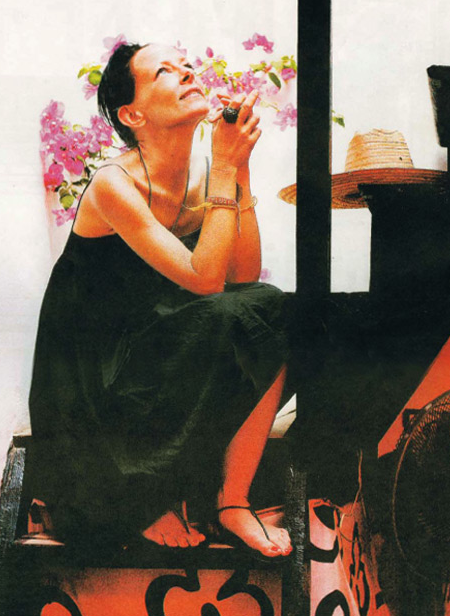
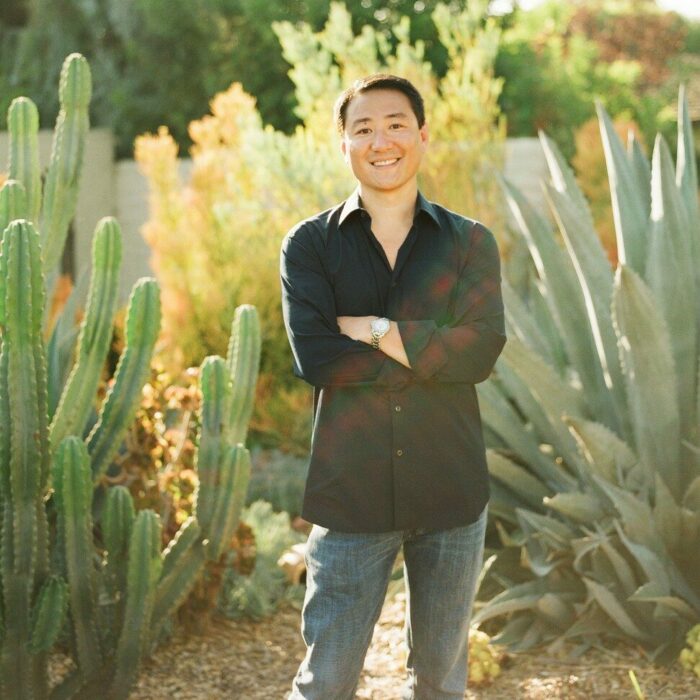
Scosha Woolridge

For information about what jewelry designs are currently available, retail stores and ordering online, visit the Scosha site here.

Share the love, post a comment!

{ 3 comments }

Pigeon Toe Ceramics – porcelain designs

by admin on February 24, 2010

Lisa Jones has quickly struck a chord with her porcelain designs under the label Pigeon Toe Ceramics. Her simple shapes and restrained color palette are inspired by her love of a Scandinavian lifestyle and aesthetic, resulting in a line that is refreshingly modern and understated. Lisa taps her varied creative background and deep thoughtfulness to keep her products both affordable and of an heirloom sensibility. Based in Portland, this young artist is on the cusp of opening her own retail shop and studio showroom and sharing her knowledge and creations with a public that is already in love.

Tripod pots by Pigeon Toe Ceramics

For starting Pigeon Toe Ceramics so recently in 2009, you’ve made major progress! What inspired this leap from your previous work in graphic design, marketing and video installation?

From a young age, I’ve leapfrogged from one art medium to another and back again. I used to think it made me less of an artist somehow, to not have the one art form that I lived to work in exclusively. Turns out that my history of ‘dabbling’ really enables me creative control over all aspects of the business. It’s actually very empowering.

To answer the question, I was working a 9-to-5 as an in-house graphic designer when I decided I needed a more tactile outlet where I could turn my brain off a bit and just work with my hands. Graphic design can be very strategic and calculated, especially when you’re designing within tight brand parameters. I felt I lacked balance. So I found a local community studio where I could rent a shelf and revisited ceramics for the first time since elementary school. A few months later a company was born.

Volcano bud vase from the Raw collection by Pigeon Toe Ceramics

Scribble nesting bowls in Spring 2010 colors by Pigeon Toe Ceramics

Large tripod pot by Pigeon Toe Ceramics

How did you come up with the name Pigeon Toe Ceramics?

Credit belongs to my husband Ryan, actually, and his keen observation skills. Shortly after I started throwing again, I started to develop the business concept and first collection. I was deep in thought explaining my yet-to-be-named business idea when he stopped me mid-sentence to ask, “Do you realize that when you’re really engrossed in something you’re excited about, you stand pigeon toed?”

Some people think the name’s a little awkward, but I find it charmingly imperfect. And, of course, since I’m a designer at heart, I immediately thought about the abundance of imagery that could be associated with that name.

You’ve referenced modern Scandinavian design as an aesthetic you like. What were some of your early visual impressions that influence your work now?

The lifestyle and art of that region has had broad influence over my work — for me it’s more than just aesthetics. The social system in those countries is the closest to ideal for me – people live with less so everyone can have more. This mentality translates into an understated modernity that I really appreciate, especially in functional objects.

When I started working in video in college, I became obsessed with the filmmaking coming out of that region, especially Lars Von Trier and the Dogma movement. Of course, movies are for the most part fiction, but I appreciated the attempts to ground it as much in reality as possible, in letting a bit of imperfection and the ugliness of life in.

If Pigeon Toe were a clothing line, it would be Humanoid, which is a brand from the Netherlands (“Elegant with an edge for modern, urban warriors”).

Planed Bowl from the Furrow collection by Pigeon Toe Ceramics

You mention being inspired by ‘a new age of homegrown, Depression-era aesthetics,’ which I find fascinating. How are you approaching your work differently now than you might have in, say, 2007 before the economy took a tumble?

When I was in college, I started working for a clothing designer, managing her retail shop and helping out with marketing and web design. I have her to thank for knowing how to set up and run the wholesale and retail arms of my company. Her work is very high-end, and the clothing we carried to accompany her designs was also very expensive. And as the years passed (this is all pre-recession), I watched prices balloon far out of any attainable range for most people. I’m all for paying the price tag for a well-made item I’ll have for years, but knowing enough about materials and labor made me realize just how obscene the profits were for some of the lines we were carrying. The same thing happened in the fine art world around that time, to the point where it just felt ugly, greedy, and overly exclusive. My work and business philosophy grew in response to that experience, and I would hope that regardless of the year, I’d be pricing my work in an affordable way and making work for everyone, not just the select few with money to spare. I want to make a living, and provide a living for my production artisans that help me, not a fortune.

That said, I’m definitely more mindful of price points than I would probably be if there were more money in everyone’s pockets to invest in quality tableware. I cringe when my accountant tells me I need to up my price point, even when it’s only a few dollars. We all want nice things in our life; I just want my nice things to be within reach for everyone. Which can be hard to do when you’re making it all by hand the old-fashioned way, and locally, but I think we do all right.

Banded butter dish by Pigeon Toe Ceramics

One of the big challenges for any artist or designer seems to be that of restraint and editing their own work. With your largely white color palette and simple lines, it appears you have conquered this challenge easily. Does this come naturally to you?

I am blessed (or maybe cursed) with a strong gut instinct. My taste is fairly specific and particular, and working in design has helped strengthen my sense of color and line. Generally, I scrap an idea if I second-guess it. I think you can tell when something is labored, and I’ve found it translates fairly accurately in sales — my most popular piece (the tripod pots) just came to me on a whim one day. I like to think that my work is deceivingly simple, and the porcelain provides a smooth clean surface to let the shapes speak for themselves.

Large tripod pot from the Earth collection by Pigeon Toe Ceramics

Folded salt and pepper cellars by Pigeon Toe Ceramics

Nesting bowls in new Spring 2010 colors by Pigeon Toe Ceramics

How would you describe your various collections, and are there particular inspirations for each?

The first collection I made was Askew, which is table and gardenware that has been gently manipulated out of round. I enjoy the asymmetry, the perfectly imperfect, but it’s also about ergonomics. The folded miso bowl was manipulated to fit nicely in your hand as you cup it. The dent mug provides a nice recess for your thumb to rest. Around the same time, I started working on the Raw collection, which is aesthetically less unified, but all have polished, unglazed porcelain exteriors and interior pops of bright color. Porcelain can be sanded and burnished into a river rock-like smoothness, and the matte bare clay looks so lovely in contrast with glossy color. This is where I get have fun with color, without it overpowering the design.

Last fall I launched my Patio collection. I’m a big plant nerd and love being outdoors, so these pieces were all crafted as an homage to outdoor sanctuaries. I wanted to take under-designed products (like birdfeeders, hanging planters, and wind chimes) and make beautiful modern equivalents. Much of the work incorporates leather straps as hanging devices. I enjoy finding ways to incorporate other materials into the designs. We’ve definitely struck a chord with the gardenware – there really are very few options between cheap (think .50 terracotta pots) and really expensive for planters.

Folded miso bowl from the Askew collection by Pigeon Toe Ceramics

Mini Creamer from the Raw collection by Pigeon Toe Ceramics

Disc chimes from the Patio collection by Pigeon Toe Ceramics

Disc chimes from the Patio collection by Pigeon Toe Ceramics

Disc birdfeeder from the Patio collection by Pigeon Toe Ceramics

I’m about to launch my first lighting collection, called Striae. The shades were all thrown on the wheel and then slipcast for translucency — porcelain gives a lovely warm pink-orange glow when lit. The shades are unglazed porcelain and all have tiered striping and banding patterns on them. I wanted to make patterns through shadows on the surface – made possible by varying the thickness of the clay and making careful use of recesses.

Lights from the Striae collection by Pigeon Toe Ceramics

Kerr votive lantern by Pigeon Toe Ceramics

Can you tell me a little bit about your creative process, materials, and the team you’re building?

I used to worry that I would run out of ideas, but I really have the opposite problem. It’s one of the more enjoyable aspects of doing functional versus fine art work – too many ideas. I’m having to teach myself to not take on too much too soon, because my impulse is to get all of my ideas out there as I have them. But if I did that, I’d have like 200 products on my site, which would be a production and organizational nightmare. Instead, I jot down ideas in a notebook I carry with me wherever I go and focus on one core idea to build the collection around twice a year, with a few special release products in between to keep things fresh. When I add, I also subtract low-selling designs or unpopular colors.

I’ve already mentioned some of the amazing properties of porcelain, but I could go on. In addition to translucency, purity of color and smoothness, it’s also one of the strongest clay bodies around, and watertight when unglazed. It’s also the most difficult to work with and the most expensive, but the good outweighs the bad. Ceramics can be a real heartbreaker, though. There are so many steps to the process, and each one has the potential to ruin your hard work. Or make the most beautiful thing you’ve ever seen. It’s a trade-off.

Luckily, I have a great group of artists to help me. I currently have three people that help me part-time so I can focus on the other aspects of the business (like sales, books, new designs, photography, web design, marketing, shipping, etc.). I still throw about 20-30% of the product on order, but the dream team handles the rest of production. Choosing not to cast all my work means hiring skilled craftspeople to reproduce my work on the wheel day-in, day-out, which is a fairly specialized skill. We want to build a different kind of relationship to the work you own by us. It has a history — and a person behind it.

Pieces in process at Pigeon Toe Ceramics

Lisa Jones at work at Pigeon Toe Ceramics

Portland seems to have such a thriving art scene. Is there anything in particular about Portland’s culture that has made launching your line an easier process?

Everyone is more than willing to help each other out here (we’re a supportive, scrappy, resourceful bunch), plus Portland is a town posing as a big city. If you live here for a few years, you’ll realize everyone is closely interconnected. So there’s a huge web of resources and support that makes spreading the word, or getting help, much easier. I had the advantage of being connected to the art scene from going to PNCA and also in the retail/design scene from my previous job, so I basically went around to the stores I liked and talked to the owners, who I mostly knew already, and the business got off the ground really quickly after that.

I see you’re selling through Etsy and through a growing list of retailers. How are you building and promoting your business, and where do you see your work going from here?

I’m sure my marketing background doesn’t hurt, but I feel like we’re been really lucky with growth. Apart from initially getting it off the ground, I haven’t solicited wholesale business. The inquiries have all come from the shops, and they’ve found me mostly through blogs. Etsy I can tell you now is responsible for much of our press. I think mainstream media is looking more and more at design blogs and Etsy for the next big undiscovered designer, or at least unique, exclusive, one-of-a-kind content. Sunset, ReadyMade, and Country Living all found out about Pigeon Toe through Etsy. What an amazing built-in audience that is! If anything, we’re growing a little faster than I would have liked, but that’s a good problem. And, aside from a few hiccups, we’ve managed just fine.

I spend a lot of time on my newsletters, which I send off to traditional press and blogs as well as my customers. I’ve never advertised, but the word is getting out, so I attribute it to good communication skills and a bit of luck. Well, and our work’s obviously resonating with people. All the communication in the world won’t do any good if people don’t like what you’re selling.

I’m on the cusp of opening a studio/showroom space here in Portland that will gently transition into a full-fledged retail storefront (a long-held dream). That’s the next big step for us. I’ve been working out of a private basement studio for a year and want to spend more time meeting my customers! And be in a place with BIG windows and lots of sunshine. I want them to see the process while they’re shopping and talk with us about the work. The shop will have a wall of windows that look into the production studio, so there will be a very literal connection.

I’m also planning on hosting some workshops at the new space over the summer for people interested in learning to throw. I’m excited about the idea of sharing my knowledge and love with others. Both my parents are high school teachers, and I considered going into education for a while, so this I hope will satisfy that urge.

Eventually I’d like to expand the brand to other genres of housewares. That’s down the line, and I need to figure out a way to do it that doesn’t jeopardize the integrity of the brand as is, and how to do it gracefully. Expansion is often awkward and full of stumbling blocks. I’m trying to do it as organically as possible. I look to people like Jonathan Adler, who has done a great job moving from ceramics to a whole design empire without corrupting his core aesthetic or values.

Marsupial pot from the Patio collection by Pigeon Toe Ceramics

Notched bowl by Pigeon Toe Ceramics

Dented bud vase from the Askew collection by Pigeon Toe Ceramics

Since you made this big leap of faith yourself, I wondered if you have any advice for someone just starting out or hoping to make a similar change in their work?

Have a support system in place before you start – owning a business is stressful and gets more so as you add variables. Have confidence in your work and ability to make it your life. Find a good accountant to start you off right from the beginning – trust me. And don’t take out a loan until you absolutely have to. Grants are your best friend, and so are no-interest loans from your family (and there’s no shame in that).

Every day I get to wake up and dictate my own future. The choices are all mine to make. And I get to create for a living! The risk is always worth that for me.

What are some of your favorite things, whether they impact your work directly or just make you happy?

Moments of leisure outdoors — swimming at the river with my husband and dog, digging in the dirt and planting things, camping, summertime outdoor parties, coffee on the porch with a good book. Good friends over for dinner. A well-tailored garment. Blue, early morning light. Really nice product packaging. Giving presents. Oversized sweaters. Cello music. Adorable animals. Tacos and margaritas. Baths in a deep clawfoot tub.

Music plays a big part in my day; the stereo is on 90% of the time at the studio. When we’re not listening to NPR, someone puts on the iPod. Lately, I’ve been listening a lot to the Dirty Projectors, the Magnetic Fields, Bob Dylan, Dr. Dog, the Silver Jews, Beirut, Willie Nelson, Fleet Foxes. Oh, and the soundtrack to Where the Wild Things Are.

I wouldn’t survive a week without The New Yorker. And I’m a not-so-secret Lost fan. Which, by the way, is on tonight — so it’s time to go!

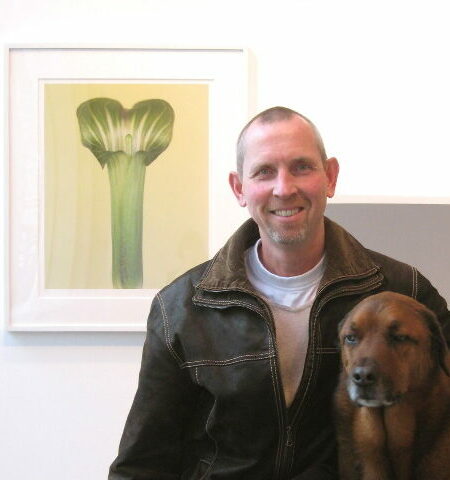
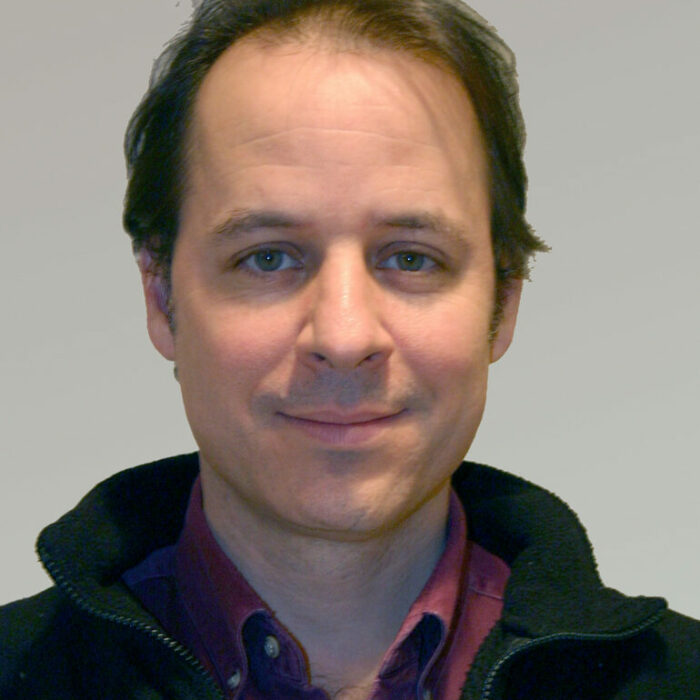
Lisa Jones of Pigeon Toe Ceramics

For a list of retailers that carry Pigeon Toe Ceramics, including online shops and the Pigeon Toe Ceramics store on Etsy, click here.

Share the love, post a comment!

{ 4 comments }

Beth Weintraub – printmaker

by admin on February 10, 2010

Beth Weintraub brings the bizarre beauty of nature to life in her prints and metal etchings. Beth originally did costume and stage prop design for dance theater and opera companies, experience that honed her ability to create on her feet and also spurred her to pursue her own art. Unlike most printmakers, she develops and arranges multiple layers of pattern and color that make each work unique. Inspired by mid-century modern furniture, Beth creates modular pieces designed to make art attainable and to make people happy.

Pluma print by Beth Weintraub (2010)

Pluma print by Beth Weintraub (2010)

The common element across your work is your subject of botanicals. Is your inspiration for these designs coming from a love of flowers or more from the decorative Art Nouveau shapes you like?

Oh, that’s a good question. You know, a little bit of both and sometimes neither! I think what I’m really drawn to is sort of the bizarro, organic shapes that appear in nature. And flowers being so appealing and lovely and readily available, it’s something I started looking at when I was trying to make my work sort of open up to the larger public. I was interested in wasps initially, paper wasps. I did a lot of research and many, many years of drawings and etchings and creative explorations about these wasps which I think are really beautiful and interesting — and a lot like people! — but they are frightening to a lot of people. So people liked my work, they liked the colors and the shapes and everything, but I’d have people come up to me at a show and say, ‘I’m allergic to wasps!’ And I’d be like, ‘But these aren’t real!’ But that happened so many times.

The gentleman down in Florida who was taking a lot of close-up photos for me worked for Busch Gardens. I found him just because he had a really cool website, and he was mostly photographing flowers, and occasionally they had these bugs in them. And they were unbelievable, high quality close-up photos. So I sent him an email, and I asked him if he had any others, and he was particularly interested in these wasps too. And he also said, ‘People don’t like it, so I don’t post them as much,’ but he started sending me photos that he was happy to let me draw from for inspiration. So I was getting both flowers and wasps in the picture, and I was starting to learn about flowers and how the little pollen bits grow and how they’re attached and just the strangeness of what was going on in these images. The bugs were harvesting the ingredients of the flower, and it was pushing me in a new direction quite naturally. And eventually the flowers became so popular and interesting to me, so I started doing more and more of that.

I like the really weird flowers — my flowers are not girly. They’re not very realistic, they’re highly stylized. And since my work is mostly in silhouette — I don’t do a lot of shading and they’re not highly detailed — I really was looking for the most unusual flowers. I like flowers that are droopy or maybe a little wilted or totally bizarre and unfamiliar. I mean, you can get flowers from just about anywhere in artwork, so I still try to set it apart as much as I can.

Thalissa print by Beth Weintraub

Thalissa print by Beth Weintraub

Triton metal piece by Beth Weintraub

Triton metal piece by Beth Weintraub

Pai Gao print by Beth Weintraub (2006)

Pai Gao print by Beth Weintraub (2006)

So it’s the shape or architectural aspect that is attracting you?

Yes, and I have to sometimes find a way to show parts of a flower that would ordinarily be hidden behind a translucent petal. You know, if you look straight on at a flower and you just take the silhouette, you don’t get what’s inside, so I contrive ways to bring the negative space in so you can see those elements. And I can do it with the brush work, but I have to give it room, because if everything is overlapped, you just have a muddy shape and it doesn’t make any sense. So I’m always making my plants more artificial looking. So the medium has a lot to do with how the visuals look and how I guide it. Over time I’ve learned how to take advantage of that a little bit better.

Thunderbird print by Beth Weintraub

Thunderbird print by Beth Weintraub

Elvis print by Beth Weintraub

Elvis print by Beth Weintraub

It’s interesting that you also cite the mass-production of modular furniture of the ’50s and ’60s as an inspiration for the way customers can group your pieces. Did your work start out with this modular concept in mind? And do you sort of bounce back and forth between Art Nouveau and mid-century modern inspirations?

Not necessarily. Art Nouveau is something I’m looking at specifically as a personal interest, and I really did use it to draw from for my current series. But I just was always fascinated by the kind of space-agey look of a lot of furniture which for me growing up was old! The plastic chairs that stack, the way chrome tables could be altered to fit different size pieces of glass. There was just a lot of furniture in my life growing up that was like that. We had a modern home, and I saw my mom putting crazy colors together. And furniture that, when you see one of them, they’re really beautiful. And some people realize, ‘Oh, well, they made 20,000 of them and they’re everywhere.’ And a lot of people dismiss that, but I found that really intriguing. Usually they’re designed to cut down on space, so you can stack them, you can put them away or they fold up.

Also at that time there was a lot of new technology and new plastics being developed, so the type of furniture we started seeing in that time period was more and more interesting. I am terribly interested in furniture in general, but I just don’t have any idea how I would pursue a career in that! Somehow art was easier — can you believe it?!

So for a long time I worked for the San Francisco Opera, and before that I was working for a Broadway costume shop in New York. So I was a craft artisan making other people’s images come to life, right? I worked off of their renderings, their sketches and direction, little swatches of fabric, and we had to make everything come to life that way. And I didn’t want to do that forever — I didn’t like creating other people’s visions as my primary creative outlet. But some people do, and that’s perfectly fine! But I wanted to kind of go back to printmaking, which was something that I loved, loved, loved in college. And I was kind of doing it on the side after work as my own pursuit, and I wanted people to take my work home and enjoy it.

Girl 70s wall metal by Beth Weintraub (2008)

Girl 70s wall metal by Beth Weintraub (2008)

How did you make the transition to doing art full-time?

There are ways in San Francisco for people to participate in open studios and things that bring a lot of the general public in, and I was just starting to experience that — this was probably ’95 or ’96. I started selling my work, and people liked it. It was not a body of work that was very cohesive — I had flowers, I had wasps, I had abstracts, whatever I was making. And people would come to me a year or two later and say, ‘Oh, my god, I love your work, but it is still under the bed unframed.’ And I started thinking to myself, ‘That pains me terribly! I don’t want that to happen.’ And I can’t make a living doing it this way. Because it’s printmaking, right? You could conceivably make a series of 100 prints, all looking the same, and sell them for a price. And I could see that that was logical and had potential to it, but the value’s quite a bit lower when people think about prints. And the digital age having grown quite a lot, especially in the end of the ’90s, I didn’t want to be confused with that. People don’t think of prints anymore as being a fine art, because they’re often not made by hand anymore.

So combined with this idea of wanting people to be able to take my work home and not have to deal with framing, I started experimenting with mounting it so that when they bought it, it was already done. And I don’t really like standard framing, aside from the massive expense and high level of skill and detail work involved in doing good framing, I couldn’t approach it that way. So I started asking carpenters that I knew who had workshops in my building, ‘Could you build me a box this size?’ And it started out in a really different format where I still had plexiglass and these tiny little pins holding it away from the print. It was kind of like mounting — or edgeless framing, I guess you could call it. It started getting people to walk away with a piece that they were going to hang up the minute they got home. So I started seeing something happening there.

And then I wanted to quit my job at the opera and do it full time, and I really had to think, ‘What can work here?’ I started to consolidate, so my shapes turned into squares, and everything was the same size so that everything that I stocked matched and every box was able to be the same size. It really made storage easy, it sort of lent itself to my material, and I designed it so that it used the most of my material without creating any waste. And the modular idea was starting to take shape because everything sort of fit together. And then I had this idea: it was so hard to get people to buy one piece of art sometimes, and I thought to myself, ‘Well, what if the one piece isn’t really super interesting, but if the group of six is really interesting and they buy all six?’ I went to a home design tradeshow, and I showed this — and it worked! People ordered that set ten times over, I couldn’t believe it! So it became a more marketable idea, really looking at my artwork as product. Some people totally reject that, but I didn’t want to be waiting for a gallery to come along and find me and do it for me. I wasn’t even sure if I was gallery-quality — or I wasn’t at the time! And the galleries have 150 artists in their stable and they’re not necessarily pushing my stuff and it’s not necessarily out all the time, so that was a weak approach to running a business. So the idea of offering artwork that sold in sets made people really go for it. A shop could buy six, and sell two, sell three, or all six! And then they’d have a really big sale, which made them excited. And they would call and order another six from me, and then they liked me a lot because the artwork was really a concept! And that got me a lot of reorders and clientele that worked with me over and over again, and they knew what to expect too. And they also could store it just like I could — everything was very similar and matched up and wasn’t a jumble of mixed-up things.

6-piece Charon wall metals by Beth Weintraub (2009)

6-piece Charon wall metals by Beth Weintraub (2009)

Beth with grouping of her prints

Beth with grouping of her prints

I can see how your metal plates are mounted, but how are your prints mounted?

Well, it’s kind of a hand-laminated process where I seal the wood and I seal the back of the print and then I use a neutral glue and I press it down onto the panel. So it’s no longer a loose piece of paper — it becomes one with the wooden panel that I mount it on. And then I can seal it in the front with either a flat or satin finish ultraviolet varnish, or I can pour resin over it if people want a high shine. So it’s totally sealed, it’s really great against light and moisture and quite durable.

I have a guy who makes these panels. He works with Baltic Birch and this high quality American grown ply called Apple Ply, and he cuts them all for me and assembles the large ones. He can deliver to me like a hundred in a small series of boxes and we assemble them all right here in my studio. It’s easy to store, it’s easy to ship, and then I really was able to start ordering more pieces because they were even smaller.

You studied writing, theater production, and Intaglio etching and printmaking in college. Did you plan on a career as an artist? Where did you think your studies were going to take you?

I certainly did not plan on a career as an artist. I did not know the path or have any idea about what it would be like to be a business owner or even pursue galleries and so forth. As a student, I worried about getting a job, so my first jobs outside of school were in New York. I worked for DTW, which is a really high-quality dance theatre workshop in New York. I was working for the lighting designers, hanging the lighting instruments, running cable, and then at night during the performances I operated the electronic board and executed all the light cues that were programmed in during the rehearsals. So I was like a lighting technician in the beginning. It was something that I’d studied in my theater classes. And I got jobs as a scenic painter, I’m really good with the faux finishes, and I had some jobs that really were fantastic for learning on your feet. They taught me how to do upholstery and special effects like blood packs, I learned how to make blanks for different types of guns that they’d use onstage, and I started getting into props. I really learned about how to use my hands and how to make something really durable, because onstage anything can happen and the actors can be rough with stuff.

So I was just building things constantly and learning all kinds of skills with my hands, but I didn’t want to stay in theater. You know, the pay is ok when you’re 22, but the 45 year old working next to me was making the same thing! And there was no insurance, and if you wanted to join the union all of a sudden you’re just the backstage guy with a flashlight and a clipboard, and that’s not what I’m in it for either. So I knew that I eventually had to get back into printmaking, even just as a hobby after work, which is what I did. It was about seven years after I graduated before I made another etching. I was making water-based silkscreens and trying my hand at painting a little bit in my home apartment, but it didn’t really get me going. So I found a cooperative where I was able to join really affordably a really well-appointed printmaking studio and start making prints on my own without being in a classroom setting. So one thing led to another.

I had been working in this cooperative studio for maybe a year or two, and there was a woman who had a similar schedule. I really liked her work, but I noticed her materials were always causing her to complain. She was never getting the aquatints that she liked, and she just didn’t understand what she was doing wrong. And I would look over at her, and her plates looked black with dirt — they had old ink in them or something. I didn’t know her very well, so it took me well over a year to get the guts up to say to her, ‘Maybe you’re not cleaning the plates all the way?’ And she says to me, ‘Oh, yeah, it’s a funny thing — I totally clean the plates as much as I can, but I’m not sure what is going on. Sometimes they just turn black in the acid.’ And I was like, ‘Oh, my god, where did you get that?’ She was using this weird kind of metal that I’d never seen any other artist use — she told me it was a building material. And it was like a lightbulb went off, and that was it! And I was gone from my job in like a month or two after that — I just quit! I knew that was the key! And I asked her would she mind if I started using this, and I started making functional objects like lamps and bowls and trays and hanging pendants and countertop materials — and I figured out a way to control the patina forming on the metal. So she doesn’t use it that way, but I thought, ‘Oh, I’ll get into furniture design that way!’

So the first year was pretty rough after I started my business. People liked it and they ordered it, but I couldn’t really get quite enough money for it. It’s not great for lampshades because it’s not see-through — so they were a little off. But the architects and designers who were coming over to visit my studio would look up on the wall and say, ‘Well, what is that?’ And I’d say, ‘That’s a print that comes off a plate like this.’ And it just totally cross-promoted without me doing anything. And people would say, ‘We want that!’ So they didn’t want my lamps and crappy trays — they wanted the artwork on the wall. And within just a year or two, I’d phased out all that other stuff and was just doing 2D wall art. And I thought, ‘Well, this is it — I’m gonna go for it.’

Trappistine print by Beth Weintraub (2010)

Meuse wall metal by Beth Weintraub (2010)

I understand you developed your own methods of Intaglio for your etching process on metal. Can you describe this and what experimentation you did to get there?

Well, the material is a big factor because artist grade printing plates are very, very thick, sturdy, super-expensive. They use either copper or zinc, and they require a lot of polishing and scraping of edges. It’s a very difficult thing to work with, and you can’t hardly turn it into anything. Plus, they’re perfectly clean and shiny and you can see the relief but there’s no tone on it — it remains the color of the metal all the time. But once I went and bought a sheet of the metal this women was using and cut it up into little pieces and started trying it, it wasn’t that hard to kind of figure out what was happening and why she wasn’t getting the results she wanted all the time. So I went out and bought some acid and adjusted the mix and found some ways to alter it enough to get it to work. It’s one of my little proprietary techniques, so I can’t say what the secret ingredient is.

Are the metal pieces the ones you’ve used to make the prints or are you creating these for their own sake?

They’re each their own. When I create a set of images to be printed, I retain all of those plates forever and don’t need to do the same process to get the patina. That woman’s process leaves a little bit of particulate on the bitten part and it does sort of affect the metal and it’s hard to print from it reliably. So I do a different type of behavior with the pieces that are going to be used as a finished product for metal. People think sometimes that they’re buying a plate that I made their print off of — I don’t lead them to believe that but sometimes they think that. I keep all of my plates, and none of the plates I sell are printable in any way. And they’re not prints either — they’re all one-of-a-kind, hand-brushed images, singularly made.

Are they unique because each is done by hand, or are you just modifying colors?

Yes and no. So the term for this within the printmaking confines is variated edition, which means you’re not making a matched set. But in addition to just changing the color, I’m mostly making multiple-plate prints, so you don’t get the same image. The flower shape will be the same whenever I use it — so if I’ve made 15 flower designs for the season, I’ve also made 10-15 background plates, and I switch them around every time. And they’re squares, right? So I can rotate them, so not everything is facing up the same way. So literally each one can be really, really different. The composition is different, and I may mount it upside down.

Galatea print by Beth Weintraub (2009)

I see from the names of your prints that you seem to be taking a single inspiration and having fun with it — for example, the Las Vegas series and the iconic figures like Princess Leia and Elvis. Tell me about your creative process and how you create these collections.

Those were desert flowers that bloom in the night, and all I could think of is, ‘Well, it’s gotta be casino.’ So, yeah, that was kind of funny. It’s very hard to think of titles for work, because I don’t really have anything in mind when I’m making them — they’re named things like Oprah or named for real, historical or fictitious, heroic women. And the Princess Leia, Elvis, and Don King prints were from the ‘hair’ series — people with memorable hair. The titles come at the very end usually. Sometimes while I’m working or printing or developing, I might have a glimmer of ‘god, this reminds me of Don King’s hair.’ Or I’m trying to ask my assistant to hand me that plate, and I have to describe it to him because he’s got six in front of him, and I’m like, ‘Give me the one with the belly dancer thing on it.’

Princess Leia print by Beth Weintraub (2007)

Princess Leia print by Beth Weintraub (2007)

Don King metal piece by Beth Weintraub (2007)

Don King metal piece by Beth Weintraub (2007)

Sahara print by Beth Weintraub

Sahara print by Beth Weintraub

Your work is so hand-crafted, so I think it’s interesting that you came to license your designs for the Flip cameras. Do you have to approach this work differently because of the customer or design constraints?

They came to me. They’re based in San Francisco, and I happen to know one of the founders. I didn’t know he did this type of work — he’s a neighbor and I’d see him at neighborhood meetings. He asked me several times if he could come to the studio, he does these images printed, blah blah blah, and he wanted to license them. And I totally don’t like to do that for the most part. It’s a really cheapening process, and most of the time I’m approached by people who want to turn my images into cheaper art forms. And I’m like ‘No, I don’t need a copycat out there that I’ve agreed to.’ But he said he had a camera, and he called me three or four times. I explained I don’t know anything about this, I don’t do digital design, I can’t use a computer, I’m not very good with photography, and I don’t know what you need. And he said, ‘Well, all the designers that we’ve got lined up to launch this product are digital designers. We have no one who really works in real-world materials, and we’re dying for something more organic.’ And I was like, ‘OK, but you have to do it.’ And they were like, ‘We’ll do it!’ He wouldn’t take no for an answer.

So I just send them images that are already existing and that are generally older, something that I’m not currently hoping to show people. Then they send them back to me organized on the format of the camera, and I can say, ‘Increase the size’ or ‘Move it to the left’ or ‘Pick a different one.’ So they do that for me, and they actually have a lot of people who like that style! So it’s a pretty nice licensing deal. And since it doesn’t pretend to be art, I think it’s a great way for artists to license their stuff that’s not competing with themselves. And I meet people who are like, ‘You’re Beth Weintraub? I think I have your camera!’ They fish it out of their purse, and I’m like, ‘Nice!’

Vela design for Flip camera, art by Beth Weintraub

Vela design for Flip camera, art by Beth Weintraub

Circus Circus design for Flip camera, art by Beth Weintraub

Circus Circus design for Flip camera, art by Beth Weintraub

I see that new for your 2010 collection are your Metal Cubes. Tell me about this new work.

I’m really, really proud, and I’m super excited to premiere it in New York. I really wanted to get away from the look that I’ve been doing the last couple of years. It was getting a little complex, and it was pretty challenging for me to find ways to get it to be modular because they’d gotten much more detailed. The problem is there’s a lot of Chinese knock-offs out there, and they do knock off my designs quite often and almost without changing anything — it’s retarded! So I wanted to do something that is more complicated and that would bring the level of craftsmanship up and interest level up so that it would be something that is not only harder for somebody to copy. But if I was doing more elaborate stuff and wasn’t going to be able to pair them together as well, I wanted the single piece to be more interesting.

So after a while, going too modular can make it really bland, and I wanted to make something that could stand alone and be really powerful. So I started working with deeper depths, and I’m putting images on all five sides — obviously the wall-facing side is empty. And I’ve been experimenting with cubes for probably ten years — I started out making them really big, almost as big as an ottoman, but they were so much work and it was kind of hard to sell because people didn’t really know what to do with it. I mean, I hang them on the walls, but most people wanted to use them as a side table or something. And I was like, ‘Well, that’s an awfully fancy kind of side table.’ And then in the last year or two I’ve been just trying different dimensions, and I’ll show them to people. I started collecting preferences and settled on a shape and size that people seemed to gravitate towards the most. And then I started playing with putting flowers on all five sides — it’s a lot of metal work! The trim and glueing it down and getting the paint and brushwork to travel perfectly around the corner — oh, my god! I’m not sure I’ve done a good thing or not, but I’m pleased with the results so far, and it’ll only get better from here. It’s still young!

Zodiac metal cube by Beth Weintraub

Zodiac metal cube by Beth Weintraub

You seem very grounded.

I think the thing that gets the most misconstrued, not only by the public but also by other artists, is what I’m doing. I mentioned my willingness to look at my work as a product, which makes me very happy. Not everybody finds that agreeable, but I have in my personality the ability to be both a really good salesperson, a marketer, the upfront person, as well as the person who hides out in the studio for three months sort of scurrying around and developing a new body of work that is, you know, uncopyable for at least 6 months! But I also intentionally seek out ways to promote the work so that people know where the real stuff comes from and why that has value and how your life is made better by putting these things in your home. Because if you don’t look at it as a product, then people feel like it’s unattainable and it’s hard to understand and there should be something mysterious or ugly about it. My work is very nice to look at, it’s agreeable and pretty even — which I think is ok!

I want people to feel happy when they go home with something that will enliven their home and not end up with a friggin’ IKEA poster that 10,000 other people in their town have. I meet a lot of artists who are like, ‘Well, aren’t you spoiling it for printmakers by selling your plates?’ And I’m like, ‘Well, no one said I had to play by the rules — and, in fact, isn’t that ok as an artist to literally ditch the rules and do it your way?’ That’s what I’m doing. I don’t want to be the poor, suffering person who has to get a message out. I’m really not that deep. I just want to make things with my hands all day and have people like them and buy them so that I can keep working and live a nice life and buy nice groceries to experiment with at night! You know, I’m not this tortured soul — I’m actually quite a perky and happy person. My art doesn’t leave you feeling like you’re not good enough or you don’t know enough about the scene or the artist or anything like that. You know when you like it right away. And men like it too — it’s not just flowers for women.

What are some of your favorite things, whether they impact your work directly or just make you happy?

I’m really, really into cooking. I like to eat too! I’m not so much the foodie as in trying all the new restaurants and knowing all the chefs and stuff, but I really like to experiment with exotic ingredients in my own kitchen. And I think when I made my hobby my livelihood, I really had a void. And I started cooking more and more, so that’s just my passionate hobby. And if I ever say to you, ‘I’m opening a restaurant,’ remind me that I will need to find another hobby, because that will be ruined! But it really relaxes me. It’s funny, because I do all this busy work on my feet all day, and then all I want to do as soon as I’m done working and I’m exhausted is do the same thing, just with food.

My other personal interests are science fiction, Hollywood-type movies, and cheesy murder mysteries! The type of reading that I do most often is that kind of done-in-two-hours murder mystery that’s virtually the same as the last ten that that writer put out, but I can’t get enough of it! Oh, and I have a particular genre — do you know how many sub-genres there are of murder mysteries? I like female detectives based in the countryside of England. But I do read all kinds, and I’m a huge Spencer fan.

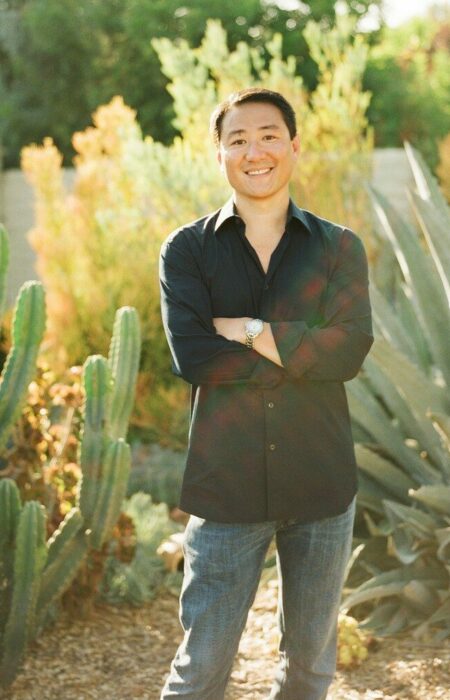
Beth Weintraub and dog

Beth Weintraub and Sultan

Share the love, post a comment!

{ 6 comments }