
Live music – various (Part 2)

by admin on April 1, 2010

I’m mixing things up this week with some great live musical performances. The collection below is sure to take you on a journey through genres and through time! Thanks to those of you who have posted comments about making big life changes in a more creative direction — I’ve got some inspiring interviews coming soon plus a new book in the works that will keep encouraging you to grab the bull by the horns. In the meantime, enjoy this little musical romp.

Pink

Here’s the amazingly talented Pink performing the Janis Joplin classic Me and Bobby McGee on the Today show.

The Cure

I’d been obsessing over The Cure‘s In Between Days for a couple of months and then was so happy to see that Apple picked this tune for one of their launch ads for the new iPad! Such a great mix of electric and acoustic and an incredibly infectious energy. Here is a classic 1986 performance at the Théatre Antique d’Orange in France. (Sorry about the subtitles, but I went with the best sound and video.)

Ricky Martin

In honor of his recent web statement, here’s my little homage to the very sexy Ricky Martin, performing Livin’ La Vida Loca live in 1999 in very sexy Italy. This man is totally free now, so watch out world!

Keane

Here’s a live performance by Keane of the beautiful Somewhere Only We Know at the Live 8 concert in London. The audience sounds great too.

Beardyman

Darren Foreman, aka Beardyman, is a world-renowned beatboxer from London with incredible improvisational skills and the ability to mimic just about any instrument, singer, or other sound. This 10+ minute tour-de-force solo performance at Camp Bestival 2009 includes a tribute to the late Michael Jackson.

Annie Lennox

Here’s the incomparable Annie Lennox at the American Idol Gives Back concert in 2008 singing Many Rivers to Cross and giving it her trademark soul.

Cat Stevens / Yusuf Islam

I couldn’t resist pairing two live recordings of Peace Train by the same man, the first by Cat Stevens during his 1976 Earth Tour and the second as his adopted identity of Yusuf  Islam at the Market Theatre in Johannesburg, South Africa in 2003. Both performances are well worth the listen!

U2

Not too many songs can boost your spirit like Beautiful Day by U2, so we’re ending on this note. This is one of the truly great bands of all time, live at Slane Castle.

Share the love, post a comment!

{ 0 comments }

Allison Arieff – design thinker, writer

by admin on March 24, 2010

Allison Arieff spends her days thinking about design and writing about its impact on our daily lives. Best known as the former editor-in-chief of Dwell magazine, Allison has also worked as an editor for Sunset magazine and senior content lead for IDEO, is a published author, and writes the By Design column for the New York Times. She sees the interconnectedness of all design, and through her writing sparks thoughtful discussion about its impact on areas such as urban planning, the economy, public health, food production, and education. Now serving as the food and shelter ambassador for the Pepsi Refresh Project and a contributor to GOOD, Allison aims to bring smart design and rich connections back to our local communities and world.

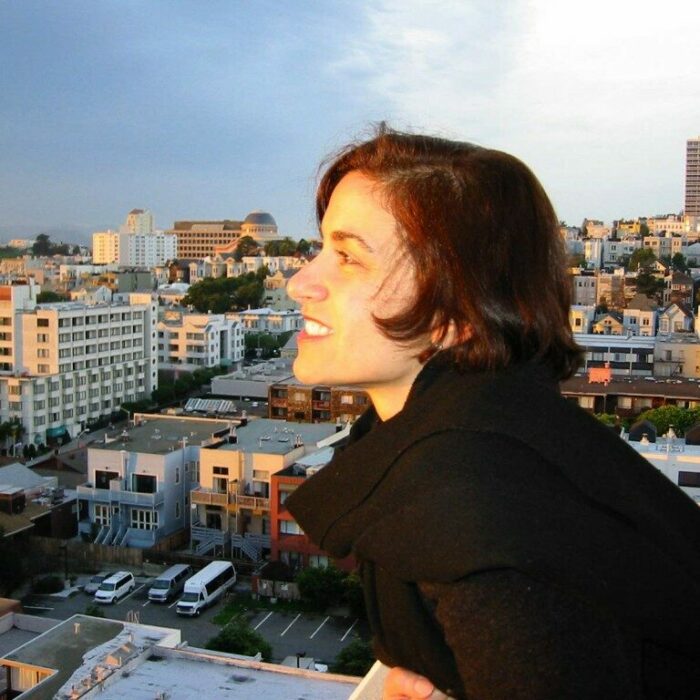
Allison Arieff at Urban Re:Vision event

You’re someone who looks at design in all its forms — from architecture to urban planning to food production to household objects and beyond. I wanted to start by asking what you would say to someone just getting started in a creative field about the importance of good design in our lives.

I think design was always kind of in my life, and I was lucky enough to have parents who had all Scandinavian modern stuff and just kind of bought well-made, well-designed stuff — not so much as a status thing but just because it was sort of the affordable, nice-looking option. So I was just sort of surrounded by all this stuff growing up, and it wasn’t until I was much, much older that it was all kind of collectible. So I was kind of oblivious to the idea of much of the stuff that I ended up writing about just because so many of these things just happened — I lived in a walkable neighborhood, and people didn’t have to write about them in quite the same way they do now.

I actually studied art and history in college and not design per se, and I definitely had some great professors who talked a lot about things in terms of how everything was related to one another. And that was always really interesting to me. Not history as facts, but history as the food part and the economics part and the war part, all kind of mixed in and sort of a picture of society. So I think I’ve always sort of approached design as just sort of one facet of that, sort of focusing on the larger picture. What I don’t like is when it gets so separated out that it becomes sort of formalist art history or something. That’s not the sort of analysis that I’m interested in doing. So I would say, especially now, the more that one can realize that everything is connected, the better — infrastructure is connected to health, safety, economics, architecture, design, etc. — that all these things kind of feed into one another. And I feel that most people look at all of these things in isolation — a bridge is a bridge, and that’s all. But you can begin to look at any aspect of anything that you’re interested in in terms of how it relates to other things and how your thinking might improve those relationships — systems thinking, call it what you will. The fact that doing X affects Y, and how can these things work in concert with one another. I think our thought processes are kind of woefully absent of that.

I ended up doing interdisciplinary work in grad school and realized that it was getting harder and harder — ‘Oh, if I finished my PhD, I couldn’t ever find anyone to hire me to teach this kind of multidisciplinary approach.’ You sort of had to have an appointment within one department of a university. I guess I feel that that’s a little bit outliving its usefulness, and I think that’s true for so many disciplines. It’s not enough to know about one thing, you have to be able to see how they connect.

I think it’s a tricky time for design right now. You know, people went to design school even five years ago — and, frankly, even now because it takes a while for curriculum to kind of catch up — and it used to be you go to design school to learn how to make things. And there’s always going to be a market for making things, but far less than there was. And the things you’re making are different and have to be changing, have to be responding to many, many different concerns — supply chains and obsolescence and all of that stuff. So much of what a lot of designers I know are doing is designing experiences or ideas or organizational structures, so I think the field is changing so dramatically. I think for people just starting out right now, it’s equally part of what you need to figure out how to do right now. A willingness to be flexible and kind of look over the horizon at the next thing coming is kind of the best skill you can have right now.

Strada 533 folding bike by Mark Sanders for Strida

You’ve emphasized something every good designer knows, to quote Eames, that good design comes from constraints. Is this the silver lining of the recent global economic downturn?

I do believe that good design comes from constraints, and yes, I believe that the recession has inspired many to be more inventive, more resourceful. This can be seen as a silver lining, but it’s more complicated than that: there are some real challenges around the economics not just of design but of creative output in general. People are creating wonderful things with less — will they ever be able to make even a modest amount of money for their efforts? I don’t long for a return to starchitect excesses or a surplus of product, but it is important that design is supported culturally and financially.

At the core of our thought process about real estate and development is this notion of ‘highest and best use,’ which rarely if ever takes into account the context of the neighborhood or larger community. Looking across a range of urban issues, from those wonderful, multi-generational hutongs in Beijing being taken over by skyscrapers, to a city like Detroit looking at urban farming as a way to revitalize itself, do you think we’ll make any meaningful progress in how we evolve urban environments until we rethink this fundamental notion?

Well, highest and best use assumes that everyone has the same interests in a particular building. So for a developer, the highest and best use is the greatest ROI, right? So I can put this many people in this big of a space and get this much money for it. And I’m making a gross generalization, but their highest and best use is high occupancy and great rate of return. And that could be diametrically opposed to the people in that building. So I think that kind of continues to be the basis for so much of what is built in this country: it’s all about cost per square foot and resale value, and very little about sustainability and functionality and livability. And that definitely has to change, but it’s really hard for that to change! Even the inhabitant of that building might not totally understand that that’s wrong.

I spent a year working for a master-planned community developer as a consultant and did a lot of interviewing with potential home-buyers and was kind of unnerved by what a premium everyone put on resale value at the expense of a lot of other things. You know, even if they were going to live in this house for some time, they were far more concerned with what they were going to get for it in the very end. And I like to think that what’s gone on in real estate the last few years is that people will step back a little bit and say, ‘Well, all these guarantees that I thought I had about increasing real estate values aren’t necessarily true.’ But — and I’m talking about residential real estate now — things that are added, put in, sizes that are mandated, etc., are not so much for the actual benefit of the people living in there but because of the perception that this is what people want and this is what people will pay for. And I kind of equate it to you write a paragraph, and then someone rewrites it a little bit — like the mission statement of an organization — and then everyone keeps taking it and editing it just slightly for their own purposes. And then you look at it a year later and say, ‘This makes absolutely no sense!’ So many people have tweaked it, and no one actually went back and thought the thing through!

So I think you can kind of look at residential real estate this way and say, ‘Well, everyone needs a Viking range!’, ‘Everyone has to have three bedrooms!’, ‘Everyone has to have this room and this much square footage and whatever else.’ And never kind of stepping back to reevaluate these things and say, ‘This is what people want, and this is what they’ll pay for.’ And as a result you get this kind of mish-mash of features as opposed to something kind of holistically conceived. So we’ve gotta get out of that.

Fortune magazine covers the potential of urban farming to revitalize Detroit

Cornfield in downtown Detroit

A hutong community in Beijing, image from Wikimedia Commons

I’m just wondering how we get out of that — as you say, it may have to start with consumer demand.

I think there’s fairly compelling evidence that not everybody wants the sort of standard, cookie-cutter subdivision house. But there’s so much reticence to change. And I’m not even talking about radical architecture, I’m talking about more flexible floorplans and living scenarios, and, like you said, the multi-generational neighborhood and really kind of designing for that. I live in a neighborhood in San Francisco that sort of as a fluke has ended up being this completely multi-generational, economically diverse neighborhood. Everyone walks everywhere, we only have one car, there’s a little sort of European shopping street — I call it ‘downtown’ — and I really don’t have to leave my little three-block radius because I have everything I need. But no one seems to ever be able to design deliberately for that. There was a series of happy accidents and arguments and long battles and all kinds of aggravation and strife to get to this point, but it’s kind of a perfect neighborhood now. And my whole thing is: how do you get there, how do you design for that? I haven’t seen much of it, to be honest. That’s kind of a big goal and hope of mine to do that.

You’ve expressed your frustration that we haven’t made much progress in addressing the problem outlined in Buckminster Fuller’s 40-year old quote below. Do you have a sort of utopian vision for how you wish we were living? And what are some of the best ideas you’ve seen for reimagining the sprawl we’ve let happen for so long?

“Our beds are empty two-thirds of the time.
Our living rooms are empty seven-eighths of the time.
Our office buildings are empty one-half of the time.
It’s time we gave this some thought.”

— R. Buckminster Fuller

I don’t have visions of Utopia. I’m too pragmatic for that, and I’ve seen too much fail. But I certainly believe things can be better — there is so much that could be done smarter. Fuller’s observation is one great example — in essence, real estate is designed and built for boom times. There is a persistent denial that we also go through of periods of bust. The cycle continues, and all the energy goes toward designing for the good half of it. But there are ways to design for both. This could mean more flexible building designs or form-based code (where the same structure can be used for multiple uses: bank, market, housing, school). Something as simple as Room Wizard (an online platform that lets you schedule room use remotely) allows for better efficiency of space in, say, an office or university building. I’m seeing building tenants share use: one restaurant operates lunch, the other dinner, or an antique store divided itself in half and now leases the other side to an urban garden store. Air B&B facilitates the renting of apartments for short term stays.

There is lots of good thinking around reimagining sprawl — most of it remains in the re-imagination stage, however. I’ve just finished an article for GOOD magazine on how agriculture might help save/redefine suburbia. Galina Tachieva of Duany Plater Zyberk is finishing up a book called the Sprawl Repair Kit that features pragmatic solutions for things like transforming McMansions into senior housing facilities or apartments. I hope that people will continue to get creative — I’ve heard so many developers say, for example, that subdivisions can’t support a café. Why not let an enterprising individual run one out their garage a few hours a day? People in cities do this all the time. I am confident people will walk if you give them something to walk to. None of this transformation will be inexpensive, but without doing it, so many things (resource use, pollution, obesity) will continue to get worse.

Aerial view of suburban development

The term sustainability is used across every discipline now, but Rob Hopkins, the founder of the worldwide Transition movement, talks about the importance of ‘resilience’ over ‘sustainability’ and asks, as one example, how we got to a place where food is grown so far from where we consume it. How big a push are you seeing to return to growing food locally in urban centers, and what are you most excited about in this realm?

There is an ENORMOUS push. I have a 500-square foot farm in my backyard in San Francisco where I grow beets, carrots, kale, lettuces, fava beans, snap peas. There are few things as satisfying. I could attend a panel on urban farming every other evening here in San Francisco. The University of San Francisco has an urban agriculture minor. There are more and more farmers markets, more and more community and school gardens, and even the typically conservative garden show will have a demonstration vegetable garden this year. It’s become an accepted part of landscape architecture. Detroit is poised to have the country’s largest urban farm. Vancouver just passed a resolution requiring developers to have edible landscapes as part of their projects. San Francisco is giving over vacant lots to urban agriculture. Things are really happening.

It’s at the top of the list for suburban improvement as well. That article for GOOD I mentioned looks at agricultural solutions as part of suburban retrofits. There are many obstacles, to be sure, but I love the idea of designing around an edible landscape. It could strengthen community, improve the health of residents, get kids outside and moving around, reduce population, and help insure food safety.

The revitalization of neighborhoods

Vertical farming as one example of urban agriculture

There seem to be a lot of little revolutions taking place — such as Park(ing) Day — to create a tangible example of what is possible, even if just for a short while, and push public policy faster than it would ordinarily go. I wonder if you’ve considered the role of government and how it should be adapting to our lives?

PARKing Day and its cousin, Pavement to Parks, show how grassroots efforts can really push public policy. Both programs were designed to be temporary; both were so well-received, the spaces so well-utilized, that the city took notice and has moved to make official versions. It’s a great strategy. If someone had proposed PARKing Day as a permanent installation, people would be up in arms over losing a single precious parking space. But REBAR had proof of concept — the commandeering of the parking space put smiles on people’s faces, brought more customers into local business, didn’t hamper traffic — so few could find reason to object to making it happen in a more permanent way. With budgets where they are and with levels of tension and disagreement where they are right now, this sort of grass roots activism used to initiate meaningful change seems to be the smartest way to go.

Note: pictured below are Park(ing) Day examples of renting a city parking space and creating a temporary but welcoming, park-like space.

Two examples of Park(ing) Day uses: top image Philadelphia, bottom image San Francisco

Have your thoughts about what good design means changed since having your child?

It’s interesting. We bought a house and had a child within one month. We looked for a house for a year at the top of the market in San Francisco and lost house after house and had given up — and then found a house when I was super, super pregnant, and we were like, ‘OK, let’s just do it!’ Both of these enormous changes, of home ownership and parenthood, started at the same time, so I would say the combination of those things has definitely changed my ideas about design. It’s a funny thing, because as the editor of Dwell for a long time, a lot of people have this expectation of what you must live in, and I think I must sorely disappoint those people because I don’t have a Dwell house at all! I have a 100-year old house, and I have some modern stuff and we’ve done some renovations that are more on the modern side, but I don’t have some high-design architecture house, and I certainly have a far-from-minimalist house. And now that I have a child, I don’t even know what the people who had children in these houses that we shot ever did, because my daughter’s four now and she’s like leaving bread crumbs everywhere — I mean, not literally, but she comes in and there’s just a trail. And you can fight it, and I do a little bit, but I just kind of go with it at the end of the day and just sort of shove it all aside as much as I can. But I could not keep up with some sort of hyper-minimalist interior and a four year old. And not that I lived in a hyper-minimalist home before that, but I think that’s changed a little bit.

My interest in gardening and landscape architecture, and particularly edible landscapes, has absolutely blossomed. Around the same time that we acquired this giant space and had her, and we spent a ton of time in the garden and have all these vegetables growing, and it’s really become like a family room for us. She can putter outside in the dirt and be perfectly happy and has a great awareness of the science of insects and dirt, and I absolutely love that. So that’s something that wasn’t a big part of my life prior.

Allison Arieff's own garden

Allison's daughter Emilia in their garden

To keep up on such a range of issues and events and then draw themes, trends and meaning from them, what does a typical day look like for you?

I spend a lot of time reading everything from tweets to books, going to panels and lectures, and talking/emailing/meeting with people working on the issues I’m interested in. The research part is never a chore — I’m really interested in these things, so I want to learn more. I get so much from listening to someone tell the story of their effort, the two people growing all the produce for the restaurant on their corner, the woman organizing an online platform for resource-sharing, and the like. I get to meet great, inspiring people, which is important because far too much of my day is spent in front of my computer screen.

Looking back on your years of work with Dwell magazine, plus your work with Sunset, IDEO, your books, your By Design column and work with GOOD, what do you think your greatest contribution is so far? Do you have a sense of personal mission?

I feel incredibly lucky to have been involved with all of these efforts. With Dwell, the opportunity to start a magazine from scratch was incredible — now even more so as the era of the print magazine seems to have passed. We had such an incredible team and really created something unique that quickly became part of the larger conversation on design, and that’s incredibly satisfying. Prefab — the book, the design competition, the idea — seemingly the most uncool thing ever, took off in a way that was completely not anticipated. It’s amazing really; I regret that prefab didn’t live up to its potential but now I’m seeing that its best future is in multifamily and affordable/disaster-relief housing. I’m eager to see that happen.

Issue of Dwell magazine

Prefab by Allison Arieff and Bryan Burkhart

I don’t have a formal mission — I do get excited about things, and it’s not enough for me to write about them. The Times column has been great as it’s part of the Opinion section and it’s been an incredible forum for things I’m passionate about: housing, urban agriculture, systems thinking, sustainable design. If there was a mission, it would be to not just observe and comment but contribute. Writing a critique of a subdivision is one thing, but being able to improve the way of thinking about that subdivision — how to make it more walkable, more able to foster good relationships between neighbors, environmentally responsible, design it to support local merchants — enough to change the way its built, that’s the kind of work I’m hoping to do.

Besides good design, what are some of your favorite things?

I feel like all the stuff that I’m writing about now, whether it’s housing or sustainability or architecture, it’s all nominally connected to design, but it’s sort of but almost not even my work anymore. It’s just what I do all day. I just find out about all this stuff, so it’s hard to separate those things out. Plus my husband and I do very similar things, and all the various books we’ve done, we’ve done together, so it’s been part of my familial and romantic relationship doing these projects, and it’s all very integrated into what I do.

I’m a huge, huge reader, but I read novels — I don’t read about organic gardening at night! But I read probably a book a week and just love reading novels and always have. I love going to the farmers market. And cooking food is very much a part of our lives, growing it and buying it — I really love the process of food shopping! I love being part of the neighborhood and the whole experience of selecting food and cooking it.

And I think this whole local movement that’s been happening nationwide, I would kind of extend that out past food — kind of an appreciation of everything that’s around you. And I joked about not going outside my little three-block radius, but I really just love my neighborhood. We have a giant park and lots of friends close by, and I’m really enjoying that proximity. And it’s familiar, but there are new things and new people all the time too.

I feel so lucky that I get to spend all this time researching and inquiring about stuff that’s really interesting to me and just kind of meeting people and talking about these things. And really making sure I’m not doing it online all day but really getting out of the house and having face-to-face conversations. I think that’s one of the big challenges for everyone right now — remembering that, yes, you can get an amazing amount of stuff done online at your computer, but I think people are just sort of losing sight of what it’s like to sort of get out there. I just really love this mix of circumstances I find myself in right now.

Allison Arieff

Follow Allison on Twitter.

Share the love, post a comment!


{ 2 comments }

Theo Chocolate – artisan chocolate maker

by admin on March 11, 2010

Joe Whinney has built Seattle-based Theo Chocolate into the artful business it is today. What began as a childhood love of chocolate turned into a personal mission when Joe began working with Mayan cocoa growers in Belize. The only organic, fair trade, bean-to-bar chocolate maker in the U.S., Theo has brought superior taste and luxury back to what was once revered as the food of the gods. Artisan confections and chocolate bars ranging from classic to fantasy flavor combinations make up the product line at Theo. Joe’s vision goes far beyond mere product to include Theo’s Chocolate University and an unwavering commitment to enriching the lives of everyone from cocoa growers to fellow chocolate lovers.

Single-country Origin chocolate bars from Theo

Theo is the only organic, fair trade, bean-to-bar chocolate factory in the U.S., and a great example of taking a more holistic approach to doing business. Can you talk a bit about what the word luxury means to you?

Luxury is something that we enjoy, something that’s rare and not very common, and also something that is, in my opinion, really good for everybody who helps to create it and who enjoys it. It is kind of an interesting juxtaposition when you think about chocolate, because the industry, the products that most people consume and what most of the industry is producing, are really sort of these commodity-type products — you know, brown, cheap and sweet. And they’ve taken what really historically has been this gift from God, these cocoa beans. To the Mayans, it was almost a religious component of their lives. Not only was it money, but it was used in a lot of their religious rituals, the color of the drink was similar to the color of blood, and they felt it was given to them by God. So something that is of that extreme value, to bring it down to what I think overall is a very base level, there’s no luxury in that! Although it could be a very luxurious product.

There’s a certain idea around hedonism, which is that hedonism somehow for some people, they assume there’s something bad about it. It has to be an indulgence that is either not good for you or not good for someone else or that there’s some sort of negative consequence. And I don’t believe that that has to be the case. You can be hedonistic, you can enjoy luxury, without it having a negative impact on someone else.

Food of the Gods basket of chocolate from Theo

Take me back to your childhood falling in love with chocolate and pioneering the supply of organic cocoa beans into the U.S. in 1994. When did chocolate go from being this kind of love or indulgence to the basis of your career?

I didn’t exactly know it at the time, but when I was a conservation volunteer for a small conservation foundation in southern Belize — this was in the early ’90s — I had no skills at all. I had a good strong back, I was a healthy kid, so they sent me out into the bush with these cocoa farmers to help them harvest cocoa. You know, I tell this story a lot, because it was really miraculous. I had no idea how cocoa grew or where it grew, and all I knew was Halloween candy that was chocolate! And after spending the first day with these Mayan farmers in the rainforests with incredible sounds and smells and giant buttress trees and snakes, and then tasting the fruit around the cocoa seed — the seed is what chocolate is made out of — I couldn’t believe that this was chocolate! It was such an incredible adventure. And I think at that point it went from, ‘I really enjoy this product chocolate a lot!’ to ‘This is an incredible adventure!’ And I just wanted to go as deep as I possibly could.

You’ve exhibited a good deal of persistence and faith in building Theo into what it is today, from working with cocoa growers in Central America and Africa, to moving from Cambridge to build your business in Seattle, to months of planning and then a year and a half of building your factory in an historic building. Was your vision of what Theo could be pretty close to what you’ve created today?

I would say yes, although I’ve been pleasantly surprised in a lot of ways. The original plans for Theo I started cooking up, you could say, in the late ’90s around ’97 or ’98, and I was already in the cocoa industry and working with chocolate manufacturers and cocoa farmers throughout North and South America, Europe and Africa. And I started to shape a fairly good view of what I thought good chocolate was and should be. I feel like it’s still a struggle for us because, you know, organic food went through a little trajectory where if it’s organic, it must be cardboard. Organic oatmeal cookies in the early ’90s — it was like a fate worse than death! I mean, it was very healthy, but, my god, you would not want to eat it!

And now it’s gone to being a much deeper understanding and a broader tent, so to speak, and I think now organics is a much more positive thing. But the fact that we’re producing organic products buttonholes us, I think, for some consumers. And this kind of goes back to luxury. So where I’ve been most surprised is the consumer response to what I consider to be some of our finest products. The quality is so good that people have been able to sort of leap over this idea of organic and not let that get in the way. And they’re starting to see more quickly than I would have anticipated that fine and beautifully made organic chocolate is as good or better than the best chocolate creations made anywhere around the world.

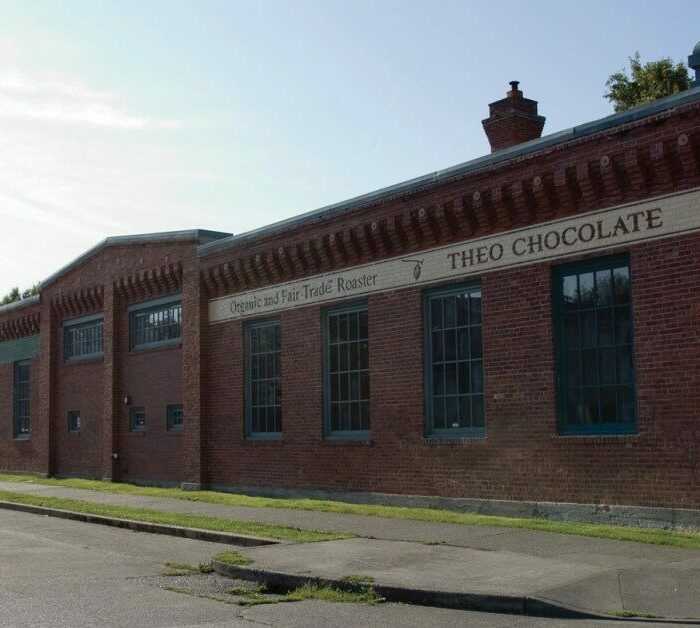
Exterior of Theo factory in Seattle

Cocoa bean roaster at the Theo factory

For those who aren’t familiar with Theo, tell us about your various product lines.

We have confections, which are hand-made ganache, pralines, artful chocolate creations that are done on a very, very small scale and are really at our premium price. On the chocolate bar side, we produce a small line of Origin bars where we name the origin country, and it’s really the most basic dark chocolate that we produce, with a very high cocoa percentage. We have a line of what we call Fantasy Flavor bars, and these are really unique flavor combinations like Curry Coconut Milk Chocolate, Fig, Fennel and Almonds, we do a Bread and Chocolate flavor, which is my personal favorite, and these are really unique and innovative flavors. And then we have what we call the Classic bar line, which are more traditional flavor combinations in chocolate like Cherry and Almond Dark Chocolate, Orange and Dark Chocolate, 45% Milk Chocolate, and these are very accessible for the broadest swath of consumers.

We’ve won awards for our chocolate bars, but the confections have really garnered a lot of attention. They’re highly perishable, so there are only a few places that we actually sell them, and they’re mostly at our factory or on the web.

Salted Caramel pack from Theo

Bread & Chocolate dark chocolate bar from Theo

Coconut Curry milk chocolate bar from Theo

Classic chocolate bars from Theo

One thing that makes Theo practically jump out at you is the wonderful branding and packaging. How did this personality and identity come about?

Thank you — that means a lot. You know, when we first started, we had a local artist Zara who did our logo and our initial packaging. And we were very clear about what we wanted, the attributes for the logo specifically. And, I have to say, it’s one of my favorite logos that I’ve ever seen — I just adore it. She was able to really capture what it was we wanted to communicate with the logo, and that’s the heart of our brand. And the packaging for me, it’s almost as though whatever comes around that is happy, because the logo is so strong.

In the rest of the packaging, we’ve done some things really well and some things not so well. One quick example is originally on our Origin bar line, which is what we were launching first, we were so enamored with Zara’s original art that we didn’t even say ‘chocolate’ anywhere on the front of the package! It was just ’84% Cacao Ghana.’ Now, if you’re a chocolate geek like we are, that might mean something to you. But the vast majority of people who encountered it had no idea what the hell this thing was! They’d say, ‘Oh, that’s beautiful!’ but they didn’t know what to do with it. So we definitely learned some lessons early on, and I feel as though we’re continuing to learn them. And there’s a lot of input that goes into our packaging, and I think some of it works well as far as communicating what the product is to people, and I think some of our packaging does not do as good a job of telling consumers what the product is.

Toasted Coconut seasonal chocolate by Theo

Vanilla Milk Chocolate bar from Theo

Big Daddy peanut butter chocolates from Theo

Also inherently part of the Theo brand is your commitment to sustainability in various forms, including packaging, sourcing, energy resources, and even fair wages and educational opportunities for the families of the growers. This is an enormously complex and challenging undertaking — how are you managing it all, and does it feel like the learning curve never ends?

Yes, it does feel like the learning curve never ends, in large part because there seems to be every day more innovation and more awareness around what social and environmental issues are. And so we always are interested in trying to be at the leading edge of this, because we do want to have a positive impact. At the heart of it, I didn’t start a chocolate company to make money. I mean, we all need to make money, but that’s not what drove me. What drove me was to create a beautiful product that really had a positive impact on everyone it touched. So it’s really at the heart of our business, and the challenge is that as a small and rapidly growing company, when your resources are really tight, it’s hard to sometimes allocate the resources that are needed to really hit that environmental gold standard. And we’ve been able to do it pretty well, but it can be challenging.

We’re four years old now, and it was very clear to me that if the company wasn’t profitable and wasn’t financially stable and had products people wanted, etc., we couldn’t accomplish our mission. So there really was a strong focus just on the basic business mechanics early on while we were doing what I considered to be baseline work around social environmental sustainability. Now that we’re at the point where our growth and our profitability are all kind of syncing up properly, it’s a little bit easier for us to try to stay at the leading edge of these issues and really provide the kind of leadership that I think we have in some regards, but I’d like to go deeper.

Going back to this whole notion of cocoa as a commodity is that since it is a consumer issue, what we’re trying to do is increase the perceived value of cocoa and chocolate products, because if we can do that and consumers are willing to pay more for something of excellent quality that they love and that is good for everyone in the chain, then we have an opportunity to pay a better price to farmers — and we do a good job with that already — but then that allows them to invest in their future, they can increase their security, and there are all of those benefits.

Coffee Dark Chocolate bar from Theo

For everyone who loves chocolate and has felt guilty about it, you’re here to assure us it’s actually good for us, right?

Yes, dark chocolate, 70% or higher. The cocoa bean is very, very complex, and it’s very similar to a lot of seeds. We think of seeds as being good for us, but most seeds are very high in fat. In the case of cocoa beans, cocoa butter actually moves through your body relatively quickly, so the calories from cocoa butter are less impactful than, say, some dairy fat. But the real heart of the health benefits are the antioxidants. The antioxidants of cocoa beans have several different benefits, and one of the most important is they are vasodilators — they open up your blood vessels. It lowers your blood pressure, helps deliver oxygen to your extremities — it’s amazing how circulation can have an impact on your overall health. And it also has the cellular benefits. We think of antioxidants as something that actually sparks or provides cellular health, and certainly those benefits are realized through cocoa.

The things about chocolate that aren’t good for you is really the sucrose or the sugar that’s added to counteract bitterness. Which is why dark chocolate is so important, because the higher the percentage, the less sugar, the more health benefits, the less you’re consuming ingredients that are not as good for you. And we don’t use any soy lecithin in our products.

You go beyond business as usual to educate the public through regular tours of your operation and through your Chocolate University. Can you tell me more about this effort?

At the heart of sustainability is that it has to be consumer-driven. So a big part of our mission is to provide information and education that allows consumers to be informed about what’s going on. And we do this across the board within our product format. So, of course, we educate about where cocoa comes from, and the farmers and the countries where cocoa is grown, but we also talk a lot about how chocolate is made. We talk a lot about what makes good chocolate so fabulous, we teach people how to make chocolate, how to work with it in their own kitchens. We also do a lot on the science behind chocolate and just how you can have fun with it and do taste pairings. And it’s really the entire universe of chocolate we want people to understand, because the more they appreciate it and the higher they perceive the value of it, the greater chance we as an industry have to have a positive social and environmental benefit. So we perceive this to be a consumer issue, and we want to educate consumers so they can make better choices.

Daily tours of Theo Chocolate

You mentioned the pairings — tell me about the wine and beer pairings on your site.

So you would buy our pairing kit, and it will come with the chocolate bars that we think pair well with certain types of beer or wine, as well as a placemat and tasting notes and suggestions. The idea is that if you wanted to have a small party and do a beer pairing, you’ll have everything you need to do that except for the beer, but we make suggestions of what kind of beer you could pair with. It’s interesting, because the wine industry has done such a gorgeous job of promoting uses of their products, we think of it from a culinary standpoint as kind of the most culinary alcoholic beverage. And the truth is that anything that has flavor really is culinary. It’s the contrast of flavors that has the most value and the most interest. So part of the reason we do beer pairings is just so that we can expand our idea about food and flavor combinations.

Chocolate and beer pairing kit from Theo

Chocolate and wine pairing kit from Theo

I’m a huge fan of Jane Goodall. Tell me about your ‘Good For All’ chocolate bars and your relationship with Jane’s organization.

It’s primarily that we raise money for her effort, which is global, through the sale of those chocolate bars. However, where there are practical tie-ins, we pursue them. So one example right now is Tanzania. Jane started her work in Tanzania, they have an environmental office there, and they introduced me to a group of cocoa farmers in the western region with a fairly large number of farmers who were interested in fair trade and organic production. We definitely saw we could have a positive environmental impact, and they don’t have a ready market. They actually do sell to some of our competitors, but the price the farmer is getting is horrible. They’re earning less than $400 a year for their entire family, and it’s certified organic. So this is a very complicated story, but the bottom line is that we now have funding under an international NGO to not only improve their quality so they can get a better price but also create market linkages with Theo and other buyers who are willing to be transparent and pay a better price. So that’s one example of how our relationship with Jane Goodall is having a practical impact on people on the planet, but most if it is us funding her work, which we’re huge fans of.

Good For All chocolate bars from Theo to benefit the Jane Goodall Foundation

What’s next for Theo and your chocolate revolution?

Well, you know, it’s interesting. We do have some new product formats coming out, but one of the things that we’re very interested in is we’ve been able to create some very delicious products in the lab only that are focused on the high health benefits of chocolate. And so it’s kind of a tricky thing, because we’re very interested in bringing these kinds of products to the market, and we have some very, very unique technology. At the same time, we want to make sure it’s consistent and meets our overall mission. So we’re kind of working through some of the product formats and presentations and production challenges, and all that good stuff. But I think what you’ll be seeing from us is some product format sizes that really drive trial, so smaller package sizes, smaller portion sizes. And then I think after that you might see some really interesting products that strive to not only to give pleasure but even provide greater health benefits than just straight dark chocolate. We’ll see!

Besides chocolate, what are some of your favorite things in life?

Oh, gosh, I love love! I do a lot of sailing — sailing’s really important to me, and that’s one of the reasons Seattle is really fantastic. So being outdoors and in the wilderness and certainly out on the water is really important. And one of the things that has really become an increasingly important issue for me is education. I have a young son who is the center of my universe, and as he grows, I’m seeing how education really can have a huge impact on people’s lives and their trajectory. So I’ve been taking a much more serious interest in education than I ever thought. I didn’t graduate from high school and didn’t go to college because school was not my bag, so it’s ironic for me now that I’ve taken such a strong interest.

And then outside of that, good food, and because of my love for food and my place in the food industry, I’ve really taken a personal interest in hunger in our communities. You’ll be seeing some stuff from Theo in the coming months around this, but in this economy, the amount of people who are hungry and who have to make choices between paying rent and buying food or buying prescription medicines, or whatever it is that is going on in their lives, it’s just astounding. So those are the kind of things that are occupying my head space right now.

Joe Whinney, founder of Theo Chocolate

For information about the full product line, seasonal items, or factory tours, visit Theo Chocolate here.

Share the love, post a comment!

{ 6 comments }

Scosha – jewelry designer

by admin on March 4, 2010

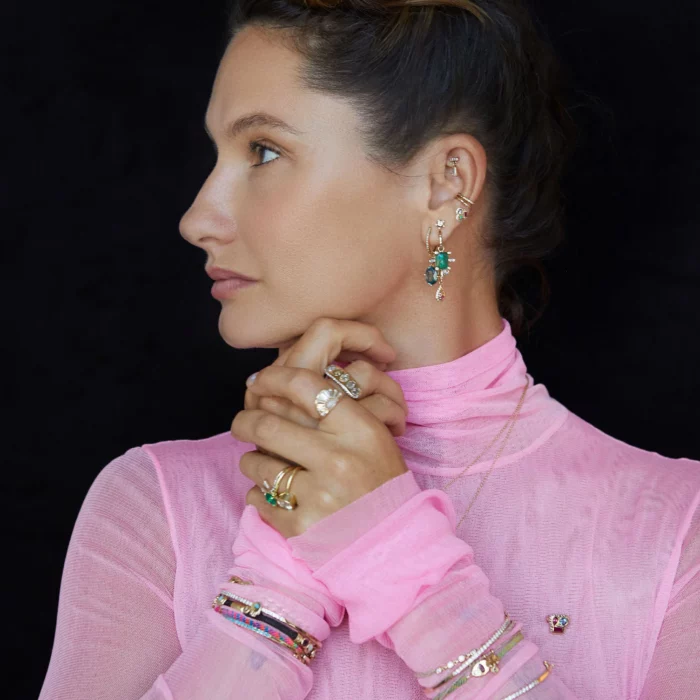
Fantasy, soul, and the natural connection of things are at the heart of Scosha Woolridge’s jewelry designs. Originally from Australia, Scosha drew inspiration from her worldwide travels before eventually calling New York City home. Her happy mix of materials — including textiles, metals, leather, and precious stones — play off each other in a way that feels raw and authentic. Scosha approaches her work as a storyteller, incorporating words and materials that together create a personal narrative. Designing for both men and women, Scosha explores the sort of truth that can only be found in things made by hand.

Women's ring by Scosha

You think of yourself as a storyteller, creating a narrative through your jewelry designs. Is this narrative coming by way of a mood, an aesthetic, the materials, or something else?

It comes from many dimensions. It’s a fantasy creature that has been in my art for many years — that is the true underlying story and a whole story in itself. Jewelry making is an extension of that character, so I would say it’s mostly emotional. I’m obsessed with and excited about how well things naturally connect, without force. Whether it’s creating an art piece, designing a piece of jewelry, building a relationship, or playing a sport, there are so many colors, textures and layers to play and build with. It really can be like teeing off on a golf game — when you hit that sweet spot, that point of perfect connection, it is euphoric, and I get the same feeling through art and jewelry making. I know people feel it too, and that is what I am tapping into. It’s that indescribable satisfaction that I always want more of, so that’s what keeps me prolific. I’m simply addicted to that sensation.

Ring by Scosha

Bracelets by Scosha

Starry Night rings by Scosha

To take this question a step further, we’ve come out of a time in which it was all about the label and the bling factor and had very little to do with personal design or meaning. How do you see your work fitting into today’s culture?

I love things that are understated, raw, nonchalant but sincerely personal, a little unkempt in the sense that they run their natural course. Anything with too much polish is like erasing the truth. Fake, cheated, unattractive.

I think today, where mass production is so in our faces and has been for some decades and will continue to be so, where certain people are lucky enough to live in the modern world but are unlucky to have been bombarded by commercialism, they still crave hand-made and soulful things. It’s part of their core, it’s as important as healthy food is for the system.

The hand-made, with all its tiny details, enables you to really look closely and explore. It can stimulate a person to go to an emotional place, which can create positive feelings, new ideas, and a healthy state of mind.

Women's ring by Scosha

Love Story necklace by Scosha

Tell me about your time growing up in Australia and any early artistic influences, how you came to live in New York, and how your jewelry design career evolved.

My family moved to Sydney when I was 5, to an urban neighborhood, a lot of bush. I was very independent and imaginative, and it was hard for me to connect to most kids because I was bossy trying to get kids to play their part in my dance shows. I made puppet shows, and I did haircuts for the kids in the streets and charged them 5 cents. I tried selling old mirrors and flowers to adults in my street over and over again. I wrote secret poems and dropped them off in random letterboxes — things like that. My mother taught me to sew really young, so I started making clothing at the age of 6. My grandmother was a painter, so I always told people I was going to be a painter or a dancer.

I became a state athlete, breaking records and doing gymnastics still while being infatuated with making art all through my primary and high school years. I did very well, and I was a perfectionist.

I knew at 17 I wanted to go traveling and learn about other cultures. I was very interested in third-world countries, because all the textiles I saw in books blew my mind, so after I went through three years in art school, I worked three jobs — as a fitness trainer, picture framer and as a waitress — to save my pennies and then flew off to Thailand and India and other parts of the globe. It was in Brazil by about the 8th month and I was seriously missing having a conversation about modern art. In Portuguese or English this conversation never could happen, so I contacted a lady I met in Mexico that lived in the west village in New York, and she offered me a job as her helper for her new boutique. I was in New York only one week and I knew I found my place in the world. It was such a mix of everything in one spot, and I liked the pace at which things moved.

I learned and made weaving in Brazil, and I brought some with me, started selling them, and then it went from there. I never intended to become a jewelry maker. I had done and was interested in so many creative things! I really wanted to make stop-motion animation and paint all day long, so it was hard to make the decision to focus on jewelry as my profession. It took me a while to accept this is what I am going to be known for. It was more that it became a demand, and I really began to enjoy the business side that I was learning. And it was the obsessive connection to people that I could achieve that really kept me moving forward.

Ring by Scosha

Braided teal linen fly line bracelets by Scosha

Moon on golden peak with diamonds and rubies earrings by Scosha

I see you mix metals, leather, recycled cotton, antique textiles, and other materials in your work. Tell me about your inspirations for these choices and your creative process in playing with this mix.

It’s in the textures, and different molecular structures — they all have their strengths and weaknesses — and I like the way this plays off together, just like people. One could say, our life is not that different to a piece of string; we both have our place. Or you could say, I couldn’t choose just one material.

Day Dusk Night men's bracelets by Scosha

Men's waxed linen rings by Scosha

Follow the Sun men's necklace by Scosha

Do you approach your collections for men and women the same way?

I think so. I make things that I would wear, and I’m strongly influence by my masculine side. I actually like menswear more than womenswear, or maybe I just like to look at men. But then again, a woman is a beautiful thing to look at too.

Woven deerskin with ID buckle bracelet for men by Scosha

Woven bracelet with sterling silver and diamonds for women by Scosha

You reference jewelry as a way to explore adventure and freedom in everyday life. Looking at your work and at some of the editorial images, it feels like this is also a subtle avenue to rebel a bit. Or maybe that’s what more personal design naturally entails! How do you see it?

I think being expressive shows a form of personal freedom, fearlessness and confidence, for which most people is a very attractive thing to have.

For whatever reason, if these things are seen as rebellious, it’s only because whoever the person is that’s making up the rules in their own mind is feeling uncomfortable. If expression makes you feel like you’re rebelling, then that’s fine too –each to their own ego. In magazines, a lot of images are cool people looking miserable. Not sure why having a sad face makes you look like a rebel. If I had a magazine, I would call it LAUGH, and every image would be so happy that you would become addicted to it because you’d feel so good after flipping through it.

Editorial images featuring Scosha's jewelry

Zac Efron wearing necklace by Scosha

Many of your designs include inscriptions, some with wording that is quite evocative. Can you describe how these words are integrated into your creative process?

It’s about the contrast of an “unsavory” word being used on a piece of precious metal. It’s about bringing yourself back to earth. The concept was a tiny little tag with an engraved inscription that you loved until you came up close and read the words, that every person in the world relates to but can have a different reaction to. That a wealthy person is no different from the working class at the core. We all talk garbage.

Thou Shalt Not Talk Shit necklace by Scosha

Rings for men by Scosha

It's my story... bracelet for men by Scosha

What’s next on the horizon for your work?

I really want to create a market for everyone. I’m aiming to get the hand-crafted bracelets made at more affordable prices. I have introduced some bronze metals so I can make bigger statement pieces, and I will always continue to use 10kt-22kt golds for higher luxury items too. It’s a different type of joy and satisfaction for each section of the pie. In the near future, I will have a store workshop so I can be more accessible.

What are some of your favorite things, whether they impact your work directly or just make you happy?

I love cats — I have three, and they are amazing, seductive creatures. They make me happy all the time. I would love a farm of all animals.

Sculpture, painting, drawing, sewing, stop-motion animation, writing little short books — I’m passionate and obsessed about all of them. They are so challenging in that they generally are about some internal growth that needs to come out. Any form of free expression impacts every part of my life just as much as snowboarding, tree climbing, genuine conversation, laughter and watching good movies with my partner.

It used to be travel, but now it’s more about the state of mind. As long as your mind’s right, you can escape anywhere, anytime.

Scosha Woolridge

For information about what jewelry designs are currently available, retail stores and ordering online, visit the Scosha site here.

Share the love, post a comment!

{ 2 comments }